


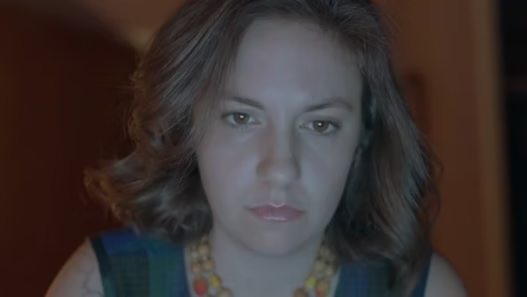





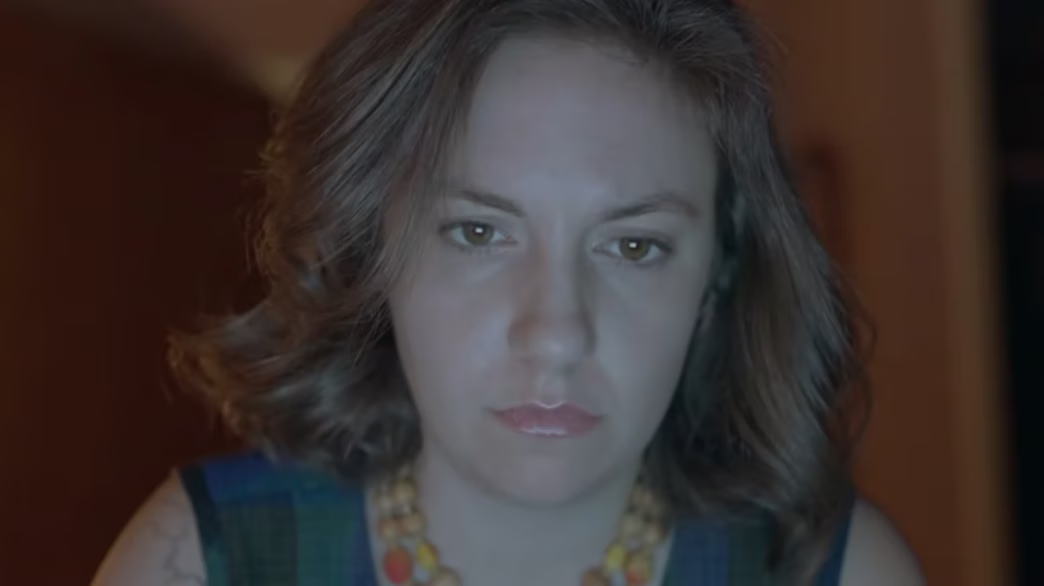
I listened to Lena Dunham’s new memoir on an endless Flixbus ride under the rain and Sunday autoroute traffic. It has quickly transformed an otherwise terribly grim journey into an emotionally intense, bumpy, and occasionally thrilling experience.
Disclaimer: spoilers ahead.
Like most Western-socialised women of my generation, Girls, Sex and the City, Fleabag, and anything by Dolly Alderton, were the building blocks on which I constructed my own coming-of-age story – an identity based on the Hannah Horvaths and Carry Bradshaws of a messy, creative, misunderstood, fragile woman with an all-consuming desire for true love and interesting stories to tell.
Girls always stood out because of Lena Dunham’s unique ability to make truly shocking weirdness somehow palatable and quirky. Watching it felt like being understood on a deeper level. Not how you want to be seen, more like the ugliness inside your soul that you’d never dare to express so eloquently.
I’ll never forget watching the famous “all adventurous women do” episode with tears in my eyes, on the day I got my HPV test results (which, in a truly Girl-esque move, was sent to my parents’ shared email account). I boogied around to Robyn’s Dancing on My Own in my university room like my life depended on it, and in a very non-literal way, it did (but in retrospect, I’m glad I didn’t follow the urge to get a tattoo with this phrase).
I followed along Dunham’s career – I read religiously her first memoir, Not that Kind of Girl (2014), now covered in dust in my childhood bedroom. And many of Lenny’s Letters, remembering Emily Ratajkowski’s Baby Woman essay, which I further dissected on Lazy Women. I watched Too Much on Netflix whilst bored and scrolling; the once punchy dialogues suddenly feeling worn and profoundly un-revolutionary.
I did my due diligence on Jack Antonoff and Luis Felber (who annoyingly puts one of his songs under every single Insta post – cringe!). I was vaguely aware of Lena’s endometriosis and benzodiazepine addiction struggles, as well as the online hate and the public sentiment that has slowly transformed her from the Voice of our Generation to uncool and un-woke.
Despite all of this, I guess I had maybe less of an idea of her as a person. Not a famous person, not a loveable person, not a role model. Just as someone who has gone through a lot of stuff. Famesick succeeds at telling exactly that.
Famesick acknowledges the faulty and celebrates our endless potential for renewal, even when at our most desperate.
The two main themes of the memoir are literally spelled out by the title: Fame and Sickness. Dealing with getting as glamorous as it gets and at the same time with the most unglamorous stuff on earth, highlighting how “celebrity is no match for illness”. Perhaps this is also why the first part of the book, focused on becoming a star and describing her early years, has more of a gossip-column feel in comparison to the emotional and more grown-upish unfolding of the latter parts of the book – addiction, heartbreak, motherhood (and the lack of it), and finding oneself again and again. Here’s what stood out for me in each of the bigger themes – and what didn’t.
1. On Fame and Spilling the Tea
Most of Part I of Famesick focuses on Lena’s early days, her route to being discovered, her hardships as a first-time director, and ultimately, what really went down during the shooting of Girls. Such as the start of her symbiotic relationship with Jenni Konner – one that will hold several surprises along the way. And perhaps most strikingly, the ambivalence between her and Adam Driver, that Adam. Dunham’s sentiments towards him range from nostalgic sadness to serious claims of verbal violence, sudden bursts of aggressiveness, and borderline emotional cheater behaviour (all of which Driver infamously dismissed at Cannes, “I’m saving it all for my book”).
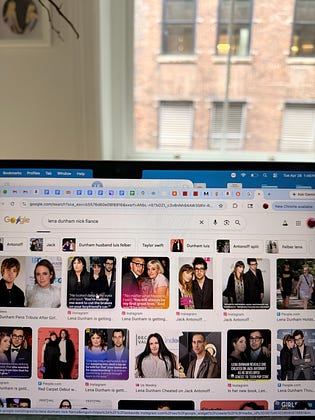
To be honest, I did get a little kick out of listening to all the drama – but in the same indulgent way as one would read a gossip column (the experience only further improved by the heavy research I was conducting on the Internet Archives in the meantime). But it also felt a bit empty and often made me question, what is the point of confessing all of this? One answer is to give us her take in a public discourse that, for over a decade, targeted and ridiculed her. Or that she just simply can’t ever stop confessing. Which can get a bit boring. The times when she goes into great detail to describe a setup or a situation (for example, the grimness of the dorm where they were staying at the first public screening of Tiny Furniture) – a cry for relatability, reaching the opposite, cringe “millennial” effect. My bitchy side is screaming, just. get. over. it. But later on, it gets trickier to do so.
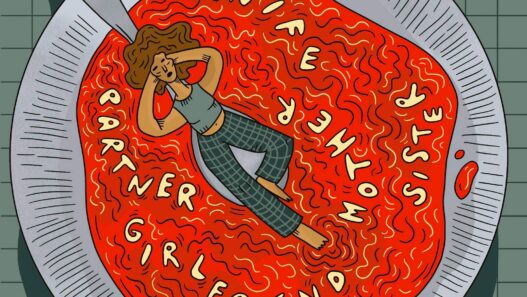
Jessica Siskin: Reading Famesick is a multimedia experience.
2. On Being Chronically Ill
The topic of fame becomes slightly more intriguing once observed in the context of the price of success. An age-old tale – how, ultimately, the kind of life that a famous creator is pushed to, and expected to live, is dictating a scary, inhuman rhythm, solely powered by the adrenaline and ego-boosts of success. One that is deeply unsustainable, and incompatible with rest, and more often than not replaced by addictive substances to reach a calm or creative state.
What struck me is that Lena Dunham truly did not ever take a break during the six seasons of Girls, which made up at least half of her twenties. If it wasn’t for a medical crisis, she was, according to her, always either writing or filming. The negative effects of this kick in progressively, in the form of a never-ending pain that nothing seems to cure.
As a fellow autoimmune-disease-ridden “girly” who used to push herself to the very limit, I related a lot more to the passages describing invisible illness – impacting more women than we could ever imagine. The helplessness of the feeling when your body (and mind) rebels against the ambitions you’ve set for yourself, and fails you in a very fundamental way. And as Famesick acutely depicts: with chronic illness, the line becomes blurrier between acute health crises and an overall identity of being the sickly person, in which even when your symptoms calm down, your brain is still screaming “but I’m not well!”, making it increasingly difficult to separate what’s real from what’s “purely” in the head.
When Dunham had her hysterectomy, everyone around her expected that her illness would finally disappear – she touchingly describes how it somehow disappointed and even upset everyone around her that it didn’t. Yet another let-down she was, for some, perhaps even more so without her womb. The moment when she reflects that the only thing she could offer a future child was her ability to face the reality that she could not carry one herself felt especially heartbreaking. To me, it read as a genuine moment of growth – something far deeper and more affecting than the turbulence of celebrity relationships.
+1 On love, and the In-Between
There are so many things I could highlight related to Lena Dunham’s never-ending quest for love. Not to mention that I haven’t even touched on the book’s exploration of addiction, but I don’t want to spoil the entire thing.
Instead, I want to focus on one particular aspect of love, something I feel remains often under-discussed: that even if you’re in love with someone, they might not bring out the best in you. Which can worsen both chronic illness itself and one’s focus on it. My theory is that in Lena’s case, something about Jack’s vibe was not really the right one to allow space for her to get better. It seems like she constantly had to prove to the world, but also to Jack, how awful she felt.
There’s a tear-jerking passage in the book when Jack finally realises, after a surgery, the depth of Lena’s pain – at least for a moment. Even so, I was left with the impression that he was desperately trying to make her get better and reassure her, rather than fully accepting and validating what she was experiencing. Paradoxically, that can make the mindset of someone living with illness even harder to bear, because it can translate into feeling unseen.
This stands in sharp contrast to the way she describes her now-husband, Luis Felber’s approach. Rather than trying to fix her, he accepts her as someone who is ill and gives her the space to live with that reality. He treats her as a whole person while also acknowledging her need for rest and accepting her “sick” identity for as long as she needs it. Within that patience and acceptance, she is finally able to begin moving beyond it and focus on other parts of her life, because she no longer feels the need to constantly prove herself. This is something I have, to a much lesser extent, experienced myself in my past and current relationships. And this is not about depending on men – sharing your life with any other human in such a significant way means you both hold up a mirror to each other’s behaviour, and it really does matter how you react to the other person’s feelings.
So, What’s the Point of Famesick?
It’s certainly an act of trauma processing, of reclaiming and telling your own narrative. It’s also about the cost of becoming “the voice of a generation,” and later on, just “a voice of a generation”, a gradual erosion of that once-enormous cultural position. Read it if the themes discussed interest you, if you’re navigating chronic illness or addiction yourself, or if you’re simply looking for drama-filled entertainment. Potential side effects include: narrating your own life in Lena’s voice for a few days, Googling symptoms of increasingly obscure illnesses, watching the algorithm transform your feed into a millennial gossip column, and, perhaps most unsettling of all – the realisation that you’ve grown out of it.
Written by Zsofi Borsi. Zsofi is the Founder of Lazy Women. In her free time, you can find her writing an agony aunt column on Substack, or sipping on coffee in Paris and dissecting the patriarchy with her besties.


