


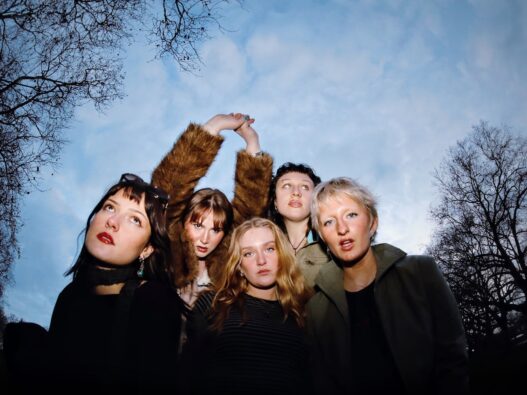
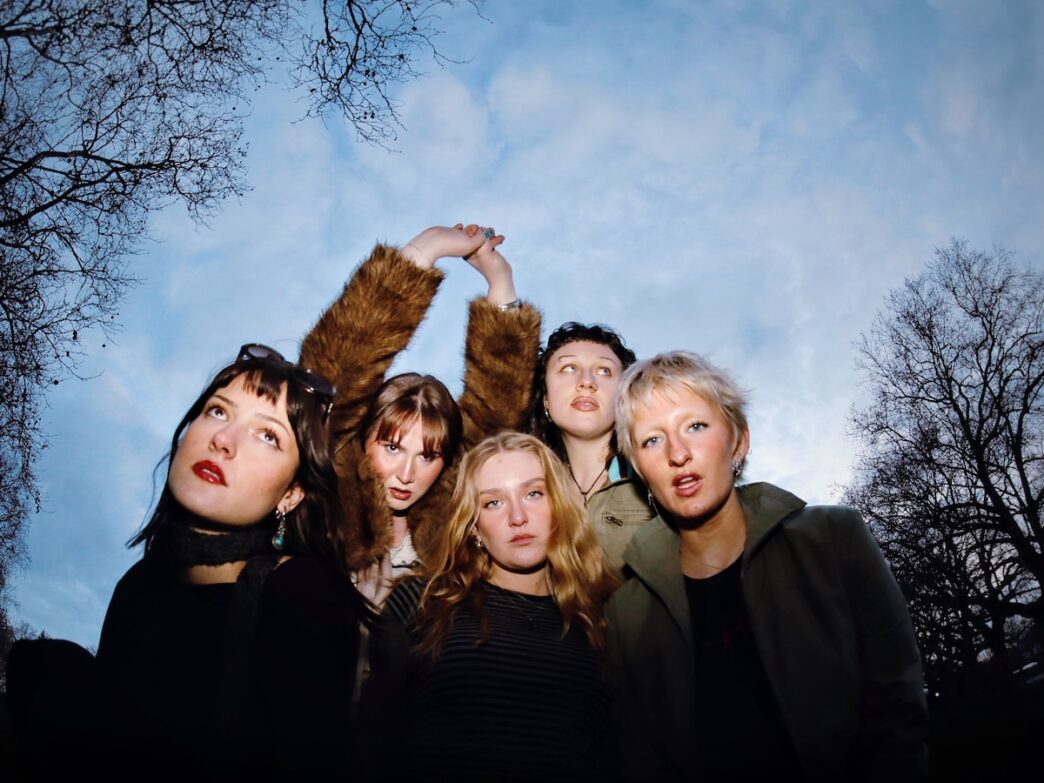
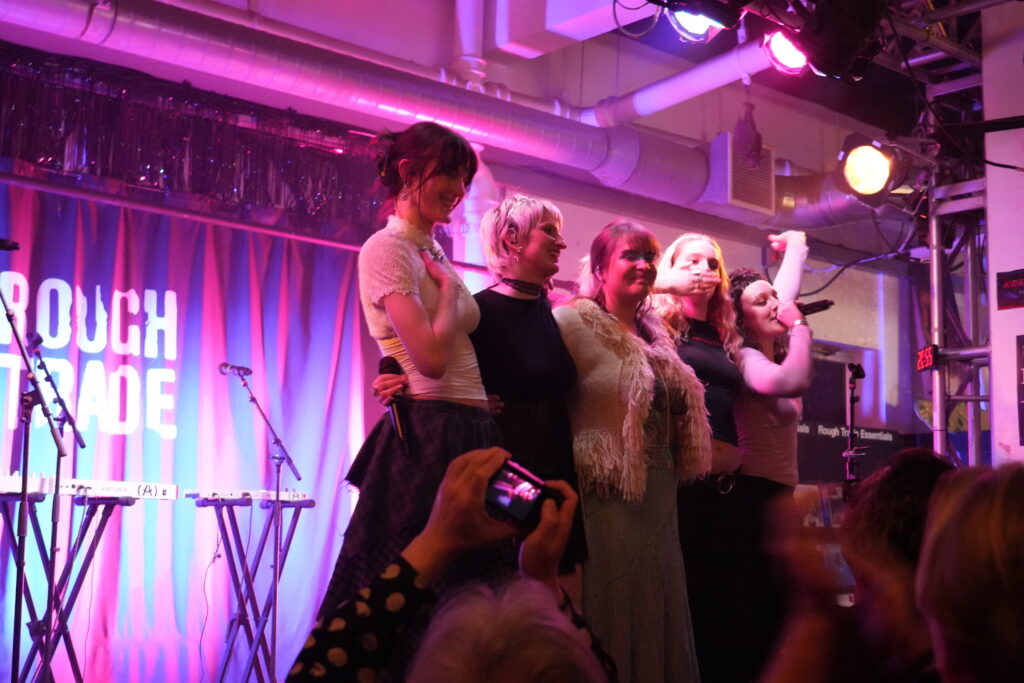
Girl Group’s preshow ritual, Mia Halvorsen tells me in the upstairs lounge of the iconic Rough Trade East in London, goes like this: He ha ho. The girls immediately cheer when I go through the motions of what traditionally serves as a theatre warm-up, and we share a laugh at my explanation that I had learnt it during a debate course in high school. Then, Mia goes on, comes the gratefulness huddle. I love you. We’re so lucky. Let’s have fun. Then, occasionally, if the mood is right, Funky Town, the Shrek version, specifically, which Maria describes as “a very important song in this band.” After the show, it’s either food and an early night, or a party. It immediately strikes me that this could easily be a chat with five of my own friends, stumbling and dancing our way through our 20s with girlish delight.
It’s the result of a simple fact. Girl Group, composed of of Katya Birkeland, Lily Christlow, Thea Gundersen, Mia Halvorsen, and Maria Tollisen — four of them Norwegian, one from Yorkshire, not York, as Lil makes sure to teasingly correct Katya at the beginning of our conversation-, is a band that started as best friends and stayed that way.
Following the success of their debut EP Think They’re Looking, Let’s Perform, released in June 2025, the band is back at it with its self-proclaimed ‘’big sister’’ EP Little Sticky Pictures. It’s easy to tell where the moniker came from. The harmonies are richer, the production bolder, the emotional register wider. What was post-punk clarity on Think They’re Looking, Let’s Perform has expanded into floor-filling dance pop without losing any of its edge. If anything, the band are angrier here, and more vulnerable for it.
The record sits in the gap between wanting to break free from the daily grind of misogyny and reckoning with how much of it has already got inside. And, refreshingly so, it doesn’t pretend that the gap is easy to close.
Goodbye Boys’ Club, Hello Spite
The story of how Girl Group came to be has been told a few times, Katya admits, and “always gets a little changed.” The bones of it are this: at the Liverpool Institute of Performing Arts, in what was ostensibly a progressive, feminist, queer-friendly space, the studio was persistently a boys’ club. Men booked it out. Women were occasionally invited in and asked to stay quiet.
“We just didn’t feel invited,” Katya says. “And so we had a really big rant about it one day at a dinner table, and realised all of us had kind of felt that.” Maria’s response was immediate: Should we not just book a studio and do it ourselves?
They did. And the first session, Mia recalls, produced something so good they knew instantly it had to become a project. “We started as best friends and just angry feminists,” she says, “and we’d never thought to write together before, because we’re very different, and our music taste is very different. So then it kind of gets pulled in every direction.”
That pulling in every direction is exactly what makes Little Sticky Pictures, their second EP, so alive. Released on March 20th, it is aptly named: a collection of familiar-looking snapshots that together depict womanhood, rendered with wit, fury, and the occasional burst of unapologetic silliness. Everything coheres around a shared sensibility: the experience of being a woman, and what you -and others- do with that.
Making It Fun Is the Point
There is a particular kind of feminist art that processes its subject matter through grief — and Girl Group are not interested in it. “So much of feminism is so sad and disheartening,” Maria says, “and I think a lot of the time it can just make you feel like there’s not a lot of power in that.” What motivates the band, she explains, is either making it sound fun or being angry about it. “Those are active motivating feelings.”
Katya puts it more bluntly: “I don’t want to acknowledge that this horrible thing is happening and then just feel sad about it.”
SuperDrug, the EP’s most streamed track, demonstrates exactly what that looks like in practice. Written as a list of medical complaints all treated with the same prescription — birth control — it sounds, on first listen, like an absurdist pop joke. To anyone familiar with the state of female healthcare, it reads as a documentary. “It’s having fun with things that have been oppressing us,” Maria says. There’s something, she adds, “incredibly satisfying about it.”
The track reaches its conclusion in a wave of analogue synths and unresolved nausea. It doesn’t wrap up neatly. It isn’t supposed to.
Thea highlights SuperDrug as a favourite, precisely for how it manages the balance. “Having a very poppy song talking about something that’s quite dark, and that all women experience — that’s a cool art form. I think we should be very proud of ourselves for making a pop banger about birth control.” Lil, meanwhile, nominates Tell Me I’m Pretty. “It’s such a bop,” she says, “and the music itself is kind of a bit of a metaphor.”
Girly Is Not a Compromise
What runs through everything Girl Group makes — the music, the visuals, the name itself — is a deliberate reclamation of things that were supposed to be embarrassing. Tiaras. Pink. Pop. The kind of girlhood you were told to outgrow, unless you wanted to be childish, basic and unattractive under the male gaze.
“When I was a teenager, I suddenly realised it’s not cool to like girly things,” Mia says. “Then you grow up and you realise you should take joy in those things.” She wrote her dissertation on masculine and feminine traits in music. “We’re so girly, and making that rebellious feels quite fun for me. That’s a feminist thing in itself.”
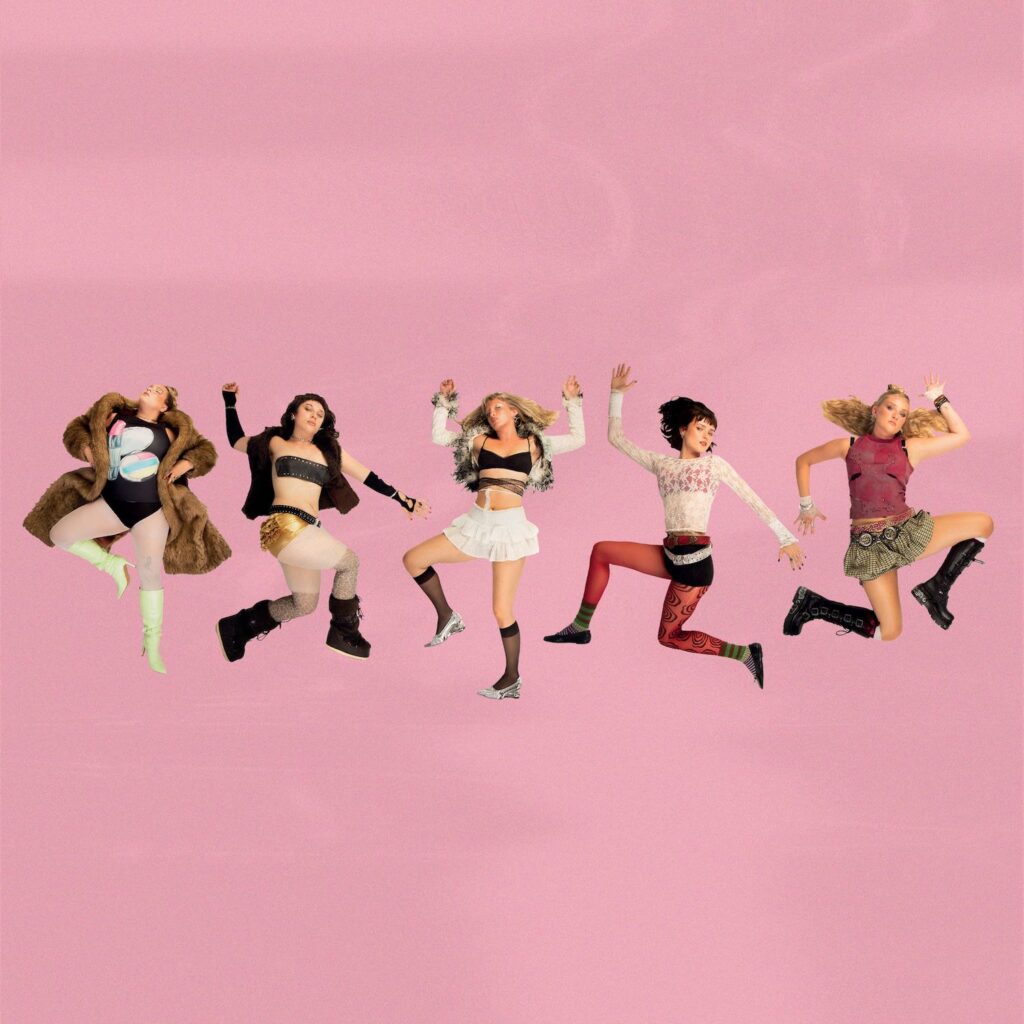
Their visual identity follows the same logic. The EP artwork features a sticker-style image with each member in a distinct “choose your character” outfit. It’s much the same style as the cover of their first EP. “We wanted it (Think They’re Looking, Let’s Perform) to look holographic,” Katya said in an interview for BRICKS. “A bit childish and fun, like we’re stuck on like stickers. The dream would be to present it with physical stickers one day.”
Girl bands are one of Britain’s most recognisable cultural exports, and the lineage is not lost on Girl Group. Lil doesn’t dodge the comparison to those who came before. “We obviously stand on the shoulders of many girl groups,” she says, “and obviously the ones who did this whole ‘choose your character’ thing best were the Spice Girls.” But she’s clear-eyed about the legacy. The girl power that reached the mainstream through them was, she feels, “perhaps a little bit of an empty sentiment.” What Girl Group are after is something more specific, more honest. “I like to think we do that on a more relatable level.”
Playing in Spite
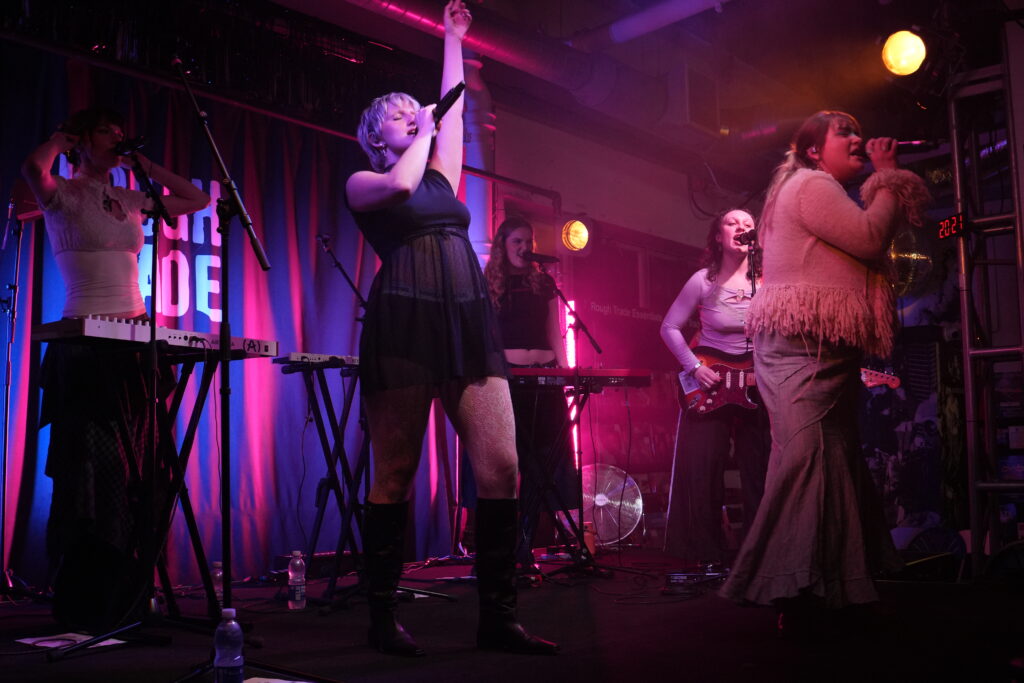
Four of the five members grew up in Norway, and the contrast with Liverpool is something they return to often. Mia has spoken before about how in Norway you are not supposed to stand out, not supposed to make much of yourself, and how Liverpool demanded the opposite. Thea, reflecting on what the past year of touring the UK has felt like, frames it as something that still doesn’t quite feel real. “Coming from a place that doesn’t celebrate music the same way, and now living this life — it’s so surreal.”
Indeed, in just under twelve months since releasing Think They’re Looking, Let’s Perform, Girl Group have appeared on Elton John’s Rocket Hour, sold out their debut Liverpool headline show, supported Olivia Dean across Paris and London — including two nights at Shepherd’s Bush Empire — and drew the most-attended BBC Introducing crowd at Reading & Leeds 2025. Four of them went back to Norway and won NRK P3 Urørt, the national television competition that has launched some of the country’s biggest acts.
What’s striking, watching them talk about their live shows, is how central resistance is to their performance. Maria describes how their set — choreography, sass, sheer forward momentum — doesn’t allow for retreat, even when a crowd doesn’t get it. “Sometimes we end up playing for people who clearly don’t really get it,” she says. “And somehow that’s been quite fuelling for us.” Playing in spite, as she puts it. “Playing with a bit of resistance really adds to our message.”
There’s something almost poetic about that — a band born from spite, sustained by it, energised by it. They came to be because a space that was supposed to be shared had been co-opted by men who deemed women as something ornamental to exist on the sidelines. Now, Girl Group has created a safe space for others who have a bone to pick with heteronormative, patriarchal structures in their own lives.
After our conversation wraps, there is a show to prepare for. A Norwegian theatre warm-up, a huddle, a declaration of love and luck. I already know the words. I reckon that other may know them too.
Girl Group’s latest EP, Little Sticky Pictures, is available now on streaming platforms and in vinyl format, which can be found here.
Written by Teodora Strugaru.
Photographs (in order of appearence) by:
Lead Photo: Serskaten
Rough Trade East Concert: Ilona Nastase
EP Artwork: Laura Braithwaite