


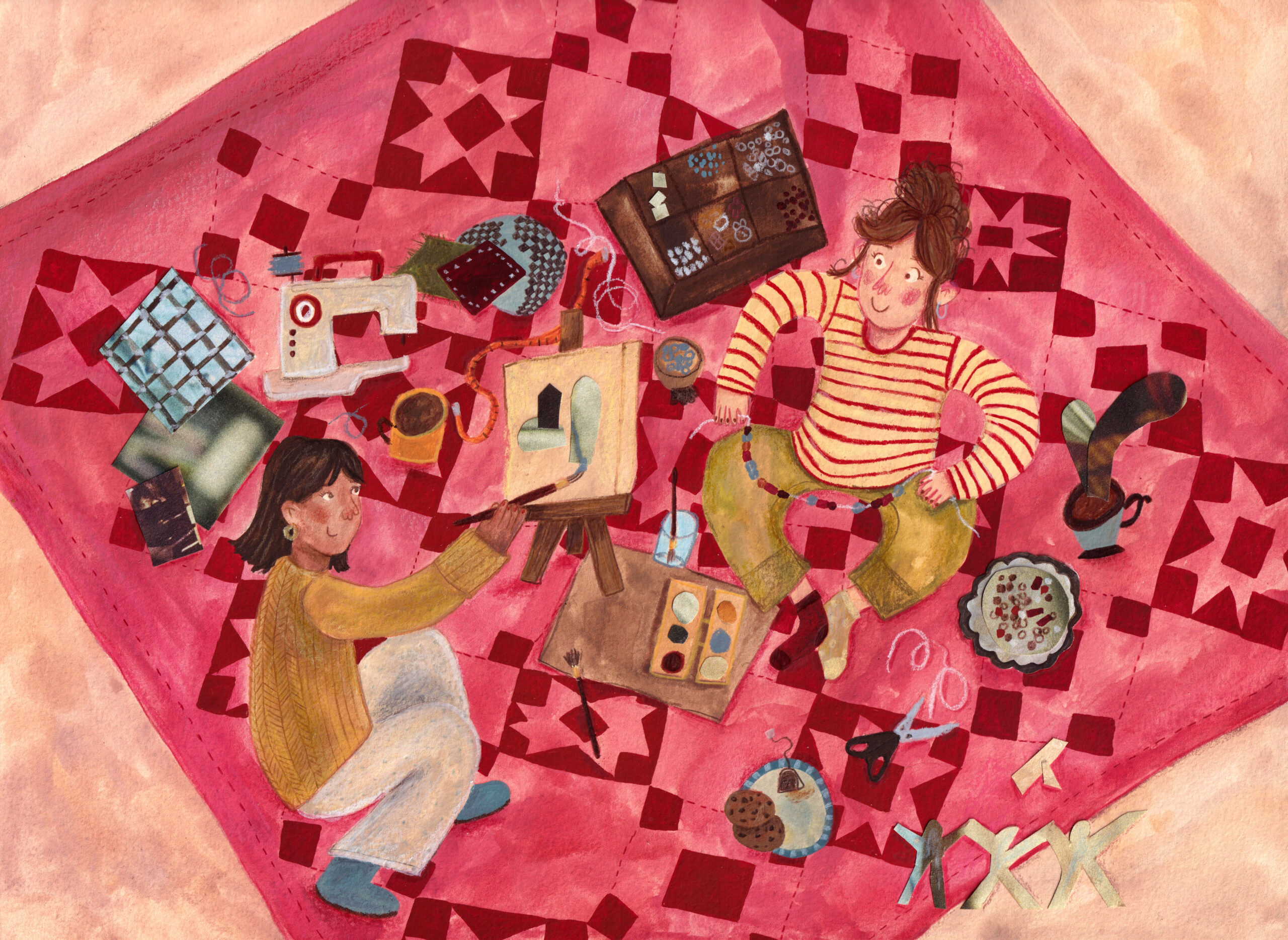










I can picture it clearly. I’m 16, sitting in my childhood bedroom surrounded by pictures on the wall, my analog camera on the bed, a canvas and dirty paintbrushes on the floor, my desk covered with colored pens, an unfinished drawing, stickers, collage materials, and my journal open. It is hot and sweaty, past 11 pm on a summer evening and the only things illuminating the room are my desk lamp and the warmth of the streetlight that shines through my window. It’s the school break and the quiet of my house tells me I’m free. Free to decide what I want to do with my time, free to explore my (often spiraling) thoughts, free to go down yet another fangirl rabbit hole (who – fictional or real – will I spend long hours and days obsessing over next, examining their every move, breath, word, creation?), free to make mistakes (supposedly).
There is a specific feeling I associate with teenagedom. My teenage years are a fog of endless creativity, hazy evenings, making impulsive decisions, spending hours and hours digging deep into a specific artist’s life until I feel there is nothing left I don’t know about them. They are also a fog of isolation, the pressure to perform and please those around me, and endless anxiety about the future.
It’s a feeling I like to revisit both as an individual, but also as someone who works with these endlessly creative, yet often anxious young people. Sometimes it’s a pleasant feeling to return to; sometimes it’s haunting. 
There is a fair amount of idealizing going on when I think about this period of life. I remember crying in my parents’ kitchen before a big exam, saying that I can’t deal with the stress, that it’s too much, that my parents have no idea how hard I have it. I also remember my Dad’s response: “Come on, I’m sure it’s not that bad. Just remember that looking back, these are going to be the happiest days of your life!”. Originally probably meant as a consolation (or perhaps as a way of unconsciously repressing the idea that his daughter could be going through a tough time), it only made me spiral more. How could they not understand?
I often have to remind myself that it wasn’t all peaches and cream because the specific type of freedom teenagedom represents to me, I long for endlessly in my adult life. According to Svetlana Boym, a cultural theorist and visual artist, nostalgia can easily become a defense mechanism in times of distress – it is a “romance with one’s own fantasy.” It gives us temporary permission to imagine and try to revisit a time and place that may have never existed in the first place.
Artworks exploring ‘coming of age’ are popular for a reason – they help us, adults, also revisit our teenage years in a way they (very likely) never existed either, and they help teens imagine a reality they long for. Adolescence is also thought of as the life stage during which our identity starts to form – figuring out who they are is literally teens’ most important task. At the same time, “who am I?” is a question we have to keep coming back to, even way past adolescence. Coming of age materials help us connect to a part of our identity we don’t regularly connect to in our daily life.
Through music and movies, these parts of our identity can come alive in a deeply visceral way, which is why I was, and am still so drawn to the movies below. This is a list of coming of age movies that I either watched many times as a teenager myself, or ones I discovered as an adult but evoked in me the same type of feeling I describe above. If you, like me, feel drawn to a romanticized (but not necessarily idealized) version of the past, these movies (in no particular order) will make this alternative version of reality come alive.
Beautiful Thing (1996) Dir. Hettie Macdonald
An unknown gem of a movie. Beautiful Thing follows two teenage boys who live in a working-class housing project in London and throughout a summer holiday, discover their feelings for each other that turns out to run deeper than friendship. Uncharacteristic of movies exploring this topic from this time period, it is a beautiful exploration of queer love that ends on a positive note. TW: this movie explores the topic of child abuse.
Ghost World (2001) Dir. Terry Zwigoff
Young Thora Birch and Scarlett Johansson appear in this movie adaptation of a comic book written by Daniel Clowes. It follows two teenagers who just graduated high school and are now trying to figure out what to do with their life. They first take pity on an older, nerdy man played by Steve Buscemi and then discover a type of intimacy that – maybe – lingers beneath the obvious. The movie touches on subjects like female friendship, clueless parents, self-expression, the power of visual art and music, infatuation, nihilism. Watch out for one of the best opening and closing scenes I have seen in a movie.
An Education (2009) Dir. Lone Sherfig
This movie and its soundtrack characterized the summer of 2013 for me. It explores the beauty and torment of asymmetrical relationships and first made me question the idea that a ‘good’ romantic partner should sweep me off my feet. It is a beautiful exploration of the need in young adulthood to break rules, rebel, go off the beaten path and constantly redefine yourself in the mirror of new experiences and people. Also, Peter Sarsgaard is hot af.
Flirting (1991) Dir. John Duigan
For me, this movie is the perfect embodiment of the psychological phenomenon that desire thrives on space – both physical and metaphysical (cue Esther Perel). The Australian boarding school this movie is set in is an ideal environment to explore the idea of being away from both the coziness and the pressures of the nuclear family, yet still being surveilled. The movie also explores how exploring your desires could actually be a form of rebelling against authority.
Submarine (2010) Dir. Richard Ayoade

If there is a movie that perfectly captures the true awkwardness of first love down to the second, this is it. It captures not only that, but also how tough it can be navigating your parents’ relationships alongside your own. It captures the pressure of ‘taking the next step’ and how, sometimes, we go to immense lengths to make something happen, even (or especially) when we don’t even know why we’re doing the things we’re doing. Through this movie, you somehow experience self-pity in the funniest, most self-ironic way. The soundtrack features young Alex Turner and puts some of the sweetness back into the awkwardness.
The Virgin Suicides (1999) Dir. Sofia Coppola

This movie is the embodiment taken to the extreme of what can happen when the natural exploration of adolescence is not permitted. I’m giving no spoilers away when I say that the story follows the suicide of five sisters who live in the suburbs of America, and you may (reasonably) think that sounds pretty grim and unwatchable. But this movie does an incredible job depicting the distortions of the male gaze and religious bigotry, and the over-mystification of female innocence – and by incredible job, I mean that it leaves up to the viewer to think what they would like to think. Bonus points if you watch the movie side-by-side with 90s female pop singers’ music videos though. TW (although I think it’s obvious from the title): suicide and emotional abuse.
Boyhood (2014) Dir. Richard Linklater
Boyhood is one of those movies that each time I see it, I notice something different about the perspective I’m currently taking. In this movie, we follow a boy’s journey through life from when they’re 5 years old to when they start attending college – both on-screen but also in real life. Yes, you saw that right, this movie took 12+ years to produce, which is both breathtaking in film-making terms, but also an incredible exploration of human development. While the movie’s main focus is Mason (the boy whose boyhood we follow), we are let into the most intimate and vulnerable aspects of parenthood as well, which now is my favorite part. Watch it only if you’re prepared to see your parents as faulty humans too.
For Some Inexplicable Reason (2014) Dir. Gábor Reisz
Set in Budapest, Hungary (and later partly in Lisbon, Portugal) this movie explores the idea that you can, indeed, ‘come of age’ again and again – that it is not something that only happens in your teenage years, but rather is a life-long process. The story is about a guy fresh out of university who just got dumped by his girlfriend. Áron has no job prospects and is either in a state of constant regression, or is just someone who never grew up – the viewer may decide for themselves. The atmosphere in this movie will be painfully familiar for someone with an Eastern European background, but its topics feel universal. Like Submarine, this movie’s ambiance is completed by its soundtrack, which was recorded by a band formed specifically for this movie.
+1
Freaks and Geeks (1999) created by Paul Feig and executive-produced by Judd Apatow
Although this isn’t a movie, but rather a 1-season TV series, I couldn’t leave it out only due to self-imposed “genre restrictions”. To me, this series is the perfect embodiment of adolescence with all its struggles and glory. It touches on topics like grief, wanting to fit in by any means possible, parental neglect, bullying (depicting it from both sides of the coin), politics, consent, succumbing (or not) to your parents’ expectations, and maybe above all, finding connection with the people around you and hopefully, in the process, to yourself too.
Written by Gitta Markó.
Gitta Markó is a psychologist, family and couples therapist in training, educator, and aspiring movie buff based in Budapest, Hungary. She is enthusiastic about sex education, pop culture, and the intersection between the two. She likes trashy reality TV, relistening to the same albums for the umpteenth time, and living slowly.
All images belong to their rightful owners and are being used by Lazy Women as part of their respective reviews.


