









“I went through my postpartum period in complete isolation. I was trying to keep my daughter afloat while I was drowning.”
Mothers don’t usually talk about motherhood like that. It may be due to shame, lack of time, or it might be that there’s no one to talk to most of the time. But if one kid meant joy and new beginnings, and at the same time unexpected solitude and desperation, giving up on having a second or a third one can silently go from being a sacrifice to becoming the only viable option.
When we talk about the birth dearth, a term coined by writer Ben J. Wattenberg in his 1987 book The Birth Dearth to describe declining fertility rates in industrialized and increasingly in developing nations, we think about figures relating to people who were never born and lives that were never lived – so you really need to rack your brains to care about it.
Numbers are just numbers, even the most catastrophic ones. That is why Italian writer and activist Francesca Bubba decided to put women’s voices into the foreground on the topic of the baby bust. She scoped out thousands of precious and painful stories, to get an honest answer to the question: why are women having fewer babies in Italy? (And spoiler alert, no it’s not just about new habits and low salaries. But paying people more would be a great start!).

In Italian, there is a specific word – denatalità – for the declining birth rate, and since 2022, Italy has had a Ministry dedicated to this issue. Nonetheless, the country recorded another all-time low, with only 355,000 newborns in 2025. Having a baby is no longer a social mandate like it was in our grandmas’ and mothers’ lives, and indeed now 5.5% of Italians say that children are not part of their life plan. But the data also shows that if every Italian woman was experiencing the right economic, social, and healthcare conditions, the babies born in that same year would have been 760,000.
What the data can’t depict, however, is what those women were thinking when they decided to give up having one (or another) kid. Simply because no one asked them. Until Bubba filled in that gap: this summer, she created a 23-question survey titled The children I wish I’d had. Over 10,000 women responded to it in three days.
This experiment alone can’t describe a country of roughly 58 million people, of course, and Bubba knows it. “This is not a representative sample of Italian women, and it doesn’t claim to be,” the writer points out. “The women who responded are the ones who read me; most of them are university graduates, in employment, and from northern Italy. The poorest women in Italy have never even seen this questionnaire.” But when one testimony starts to resemble 10, 1,000, 5,000 others, maybe the problem isn’t confined to the four walls of a single home.
It’s not just money: the hidden cost of care work
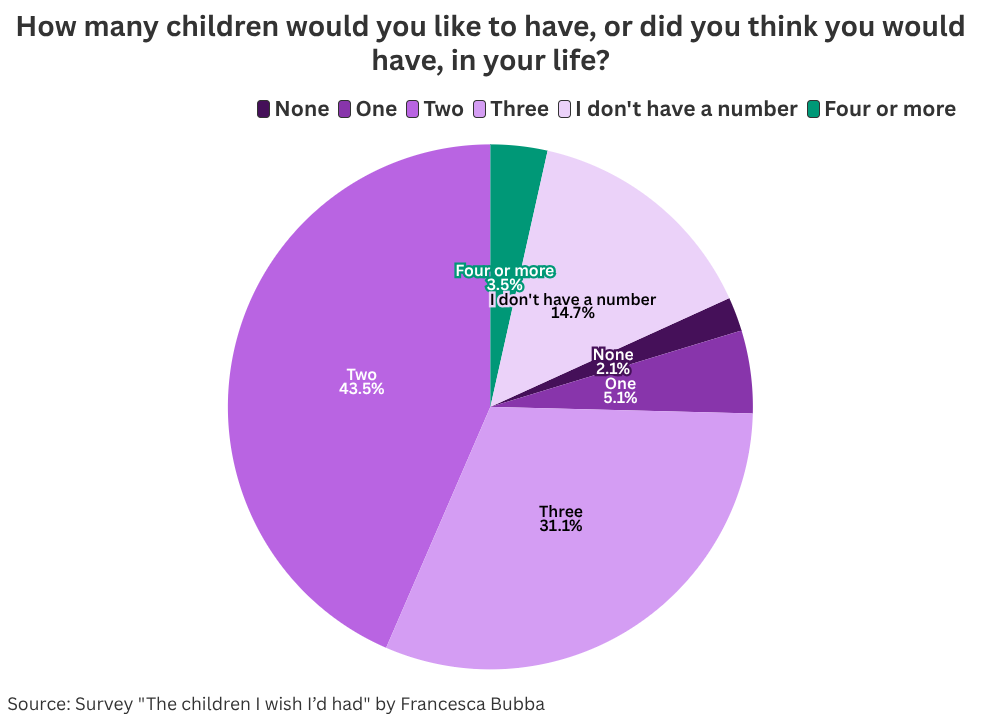
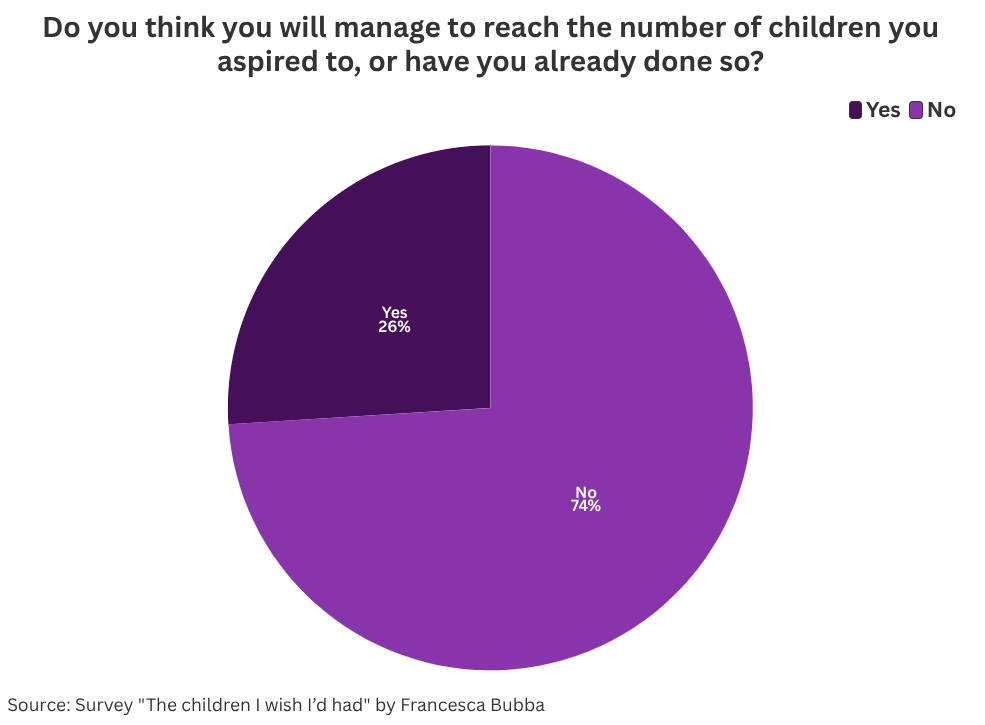
Three women in four taking the survey state they haven’t had, and don’t expect to have, as many children as they wanted. And we’re not talking about 7th Heaven scenarios: 31% of them longed for three kids, while 43% wanted only two. “It all started with a statistic,” the writer explains. “Among women who said that they wanted a child in 2016, only 42.8% of them went on to have one. Six women in ten did not change their minds in a vacuum. Something happened in between, and in Italy there is no survey about it, none that captures the living voice of those who bear that renunciation,” she highlights.
“We talked about it for a long time, ran the numbers, and one evening we had a long, endless cry when we realised we could never afford it,” is one of the answers to the question “What is the moment you realised you wouldn’t have the child(ren) you wished for?”. Another one replied: “I had my daughter at 42, before that it was impossible: precarious contracts renewed every three months, no savings, no family support to rely on.”
Often the obstacles take the form of a too-expensive nursery school, or of a real estate sales listing. Or yet a medical bill you know you can’t afford: that is why one woman in three who needed them had to close the door to assisted reproduction treatments.
“It happened when we were unable to buy the house we needed to expand our family. I cried for months,” a woman replied. “I had just come out of a medical appointment,” wrote another one.
“We looked at each other, and my partner understood that something had shifted in my head. When we worked out the cost of living together, we realised there was no room for anything else, nothing beyond a basic life.”
In other cases, the decision process was more subtle: it still involved costs and accounts, but not in euros. “I realised I wouldn’t have a third child when I felt completely alone after the birth of my second. Even though my partner would, in theory, make an excellent father, in reality, all the work of raising the children falls on me”, one woman confessed.
Almost 44% of them indicated “the amount of care work that would have fallen on me” as a main obstacle, followed by “the unequal division of household labour with my partner,” chosen by 21%.
“We work like people who have no children and take care of the household like people who have no job”
When it comes to who does what at home, there is good and bad news. The good news is, in the last twenty years, Italian women have reduced the time devoted to unpaid family work by almost 40 minutes per day. The bad news is that women still contribute 4 hours and 21 minutes every day, while men only contribute 1 hour and 54 minutes.
The fact that women’s employment rates in Italy are the lowest in the European Union (an unflattering 52.5%, against an average of 65.7%) doesn’t tell the whole story. Even in heterosexual couples, where both partners are employed, women still do 68.9% of the family work. How could it get worse? Well, you could be a mother: family work takes up 48.8% of mothers’ total working time, compared with only 22.3% of fathers’ and 32.5% of childless and single women’s. “I loved doing sports before having my child”, one mother says. “Now I barely have time to brush my hair in the morning… I really, really miss myself.”
Reading these women’s hidden aches, I couldn’t help pondering how much time has passed and how little has changed for most since Sylvia Plath wrote this in her 1963 work “The Bell Jar”: “So I began to think maybe it was true that when you were married and had children it was like being brainwashed, and afterward you went about as numb as a slave in a totalitarian state”. Esther, the novel’s protagonist, draws this conclusion just by closely observing the women in her life.
“It is the mother who notices that her daughter’s foot has grown, who knows what size the baby wore in March, who finds two hours between work and dinner, and who weighs durability against price when choosing shoes”, Bubba remarks.
In the survey, only 7.3% of fathers are said to be the sole person responsible for buying milk and diapers, and only 1.5% for buying shoes and clothes. “The task most evenly shared is the evening routine,” the writer points out. “It’s the only one that happens when both parents are usually physically at home, and the only one that nobody has to remember to do, because what reminds them is the tangible presence of the child. Everything that requires keeping a deadline in mind is mainly the mother’s duty.”
This is the so-called mental load, the invisible mental and emotional labour behind handling life’s never-ending to-do lists, which still falls primarily on women around the world. And it doesn’t start with being a mother. “I gave up on having a baby when I saw my parents become extremely dependent on me; I couldn’t do it all with another young child as well,” one of the women recounts. And another one: “I realised it when my mom got very sick, and I was her caregiver.”
This happens more and more often to what we call the “sandwich generation”: the fear of being “squeezed” between caring for children and caring for parents led 763,000 Italians to give up on having a family of their own. Even when the grandparents are healthy, they may live far away. “Without relatives nearby, our family logistics depend entirely on our own health”, one mother writes. “Any hitch throws the whole system off, because everything is built on arrangements that fit together to the millimetre.” This problem affects 1 woman in 3 who responded.
My generation (Bubba is a 33-year-old mother) found itself inheriting both the freedom of the women who left the home and the duties of the women who stayed, in the same body and on the same day,” she explains. “We work like people who have no children and take care of the household like people who have no job, and when we collapse, we think it’s our fault.”

“I decided to stop having children when, after a very hard day, I asked my husband for help, and he told me I always make the same complaints, and that all mums go through this,” another woman adds. By analysing these stories, Bubba finally offers another perspective on the birth rate: “The more alone a woman is in her own home, the more likely she is to give up on another child. Among women who handle three tasks or fewer on their own, 44.3% have given up on having another child; among those who handle six or more on their own, the figure is 56.5%,” she says.
“According to this survey, it seems that in this country there is a measurable relationship between who has to remember the paediatrician appointments and the children who are born.”
So what do we do?
“According to this sample, it may be worth considering that a decade of Italian birth-rate policy has been built on the wrong assumptions,” Bubba remarks. “The government offers between sixty and two hundred euros per month (through the Single and Universal Child Benefit) to a woman who is working out whether she will survive postpartum depression, or who hasn’t slept in four years.” The money helps, of course, but can it ever be enough? Listening to these stories and then looking at the data, the answer seems quite clear.
“What a lot of these women are missing cannot be bought. No bank transfer can get up at three in the morning, and no bonus will remember the vaccination,” the activist adds. “Money buys services, and, in Italy, the services often do not exist, and even where they do exist, they often remain unaffordable.”
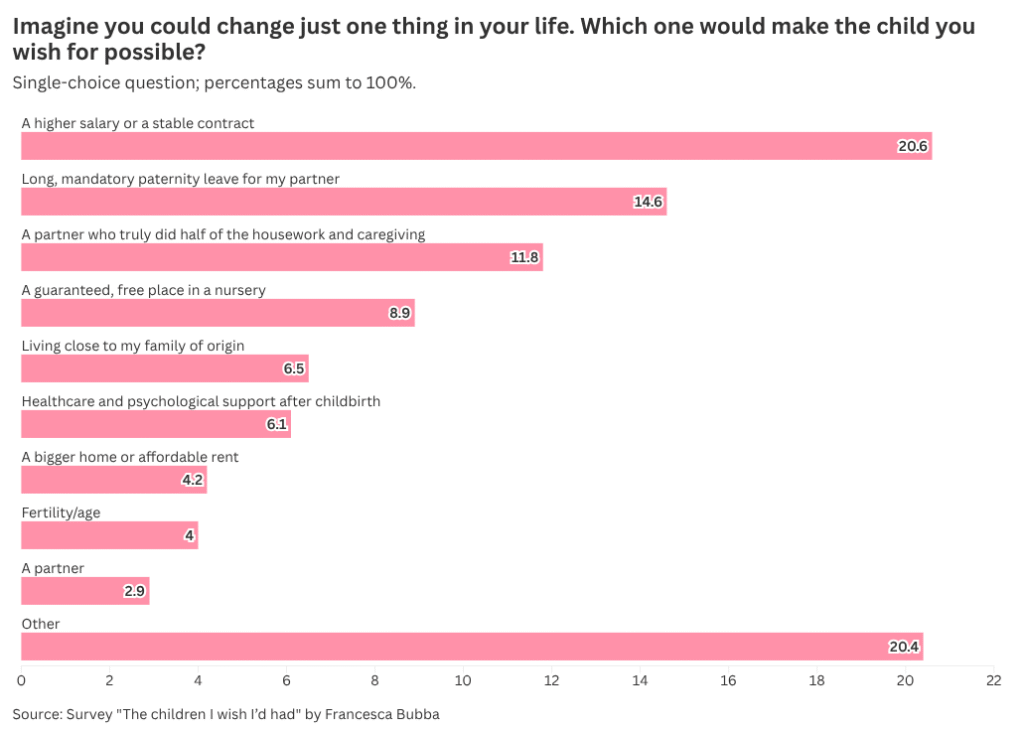
A first real answer might be closer than we think, and the women suggest so themselves: Italian fathers should be in the picture more. Last February, a bill to introduce equal parental leave of five months paid at 100% was rejected by Parliament, so Italian dads right now – and only the employed ones – can count on the minimum amount of mandatory paid paternity leave in the European Union: two weeks, ten business days. And still, only 65% of them actually took the time off, according to the latest data.
“Everything else is a concession to be negotiated with an employer who is under no obligation to grant it,” Bubba highlights. After that, he can indeed request parental leave lasting 3 to 6 months and paid at 80% of his salary. More and more fathers do so, but twice as many women as men take it, and for longer periods.
“Asking fathers to be better without ever giving them the actual time to do so is, yet again, this country’s way of offloading a structural problem onto one person alone,” Bubba concludes.
One voice, in a raging choir of unheard women, summarises it all: “Stop blaming people who don’t have children. Focus on making parenthood an experience that doesn’t come with a penalty.” The ground is already starting to shift in that direction. Together with MP Gilda Sportiello, journalist Corinna De Cesare, and obstetrician Alessandra Bellasio, Bubba brought these voices to the Italian Parliament to introduce a bill called “Parenthood Isn’t Born Alone”. The proposal includes midwife home visits within 48 hours of hospital discharge, psychological support, maternal health screenings, and care during the child’s first three years, in order to recognize the postpartum period, and not just pregnancy, as a phase that requires services and care.
Just as Italians coined the word “denatalità” for the familiar concept of the declining birthrate, Finnish people have the term “neuvola”, literally meaning “advice place”, to refer to free public clinics that follow families from pregnancy until the child starts school. If this bill goes through, Italy could have its own word for that kind of care and shift a step closer to a reality Finnish families have already known for a hundred years.
Written by Cecilia Rossi.
Cecilia Rossi is an Italian journalist focused on economic and social justice pieces for outlets such as La Repubblica and Corriere Adriatico. She received a special mention at the Marco Toresini National Journalism Award for her reportage on the forgotten outskirts between Urbino and Pesaro, in the Marche region.


