








On Paris’ Rue Montmartre, Wilo & Grove is hard to miss. Its window looks more like a cosy, carefully arranged installation than a conventional gallery display, with framed works sitting alongside sculptural furniture and glowing lighting.
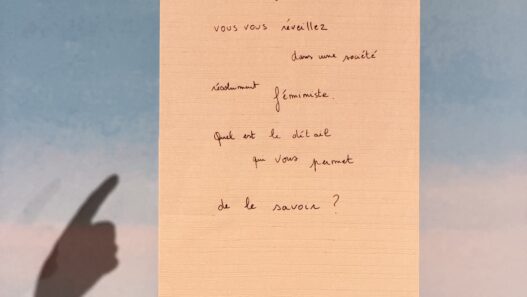
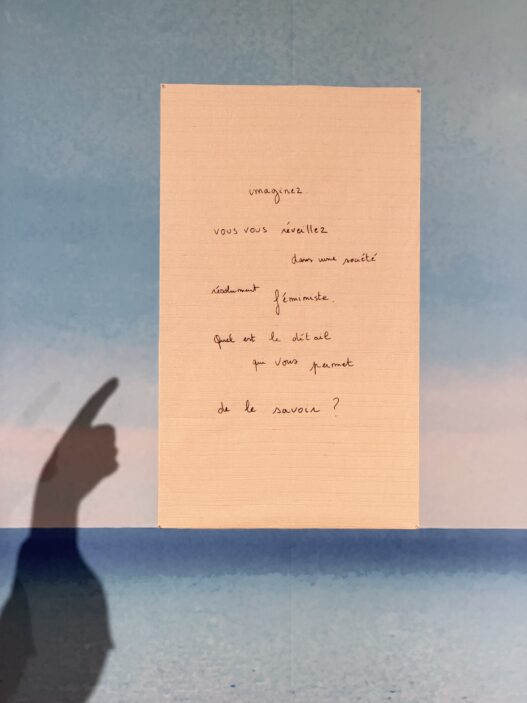
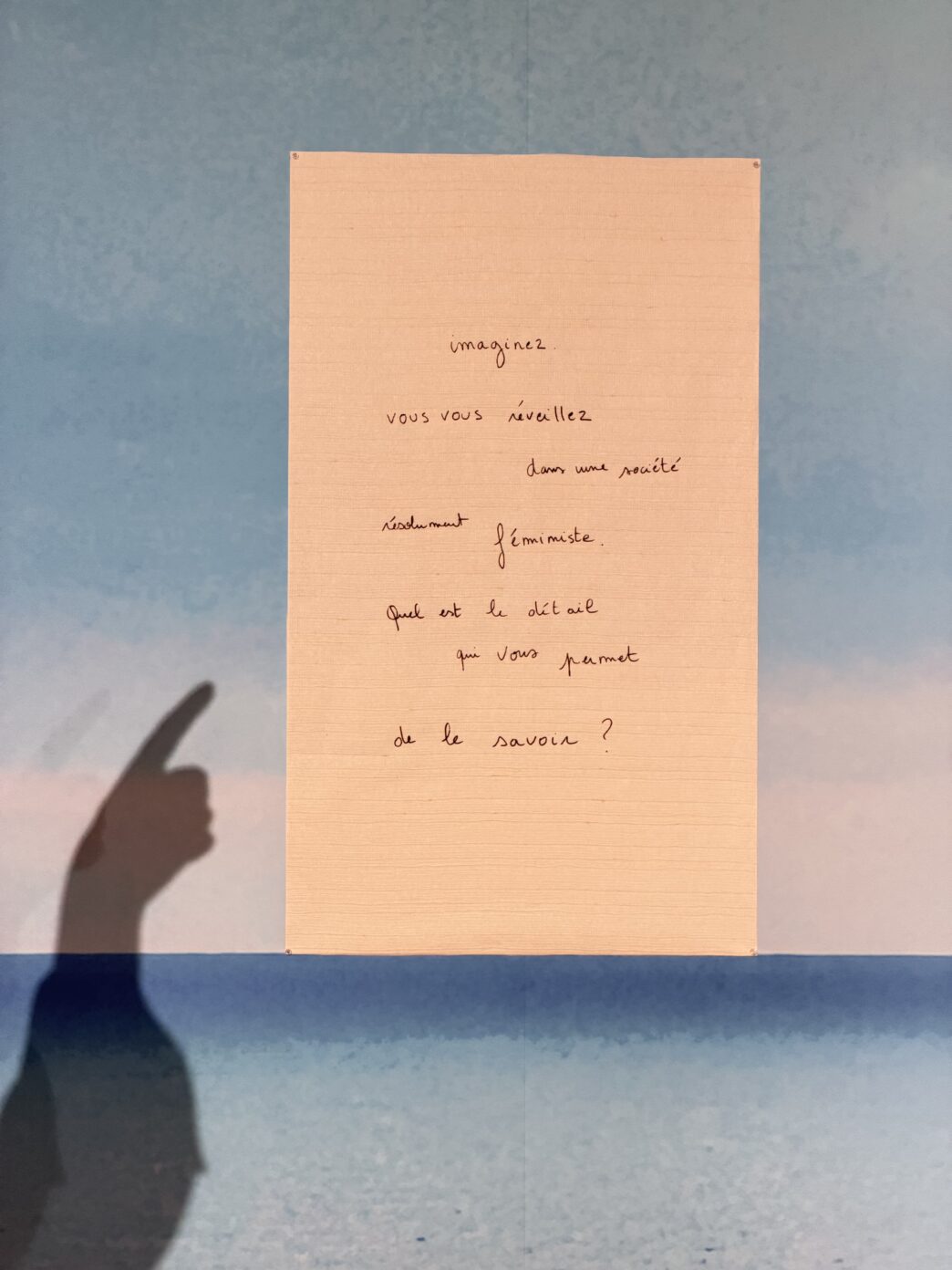
Inside, the current exhibition, La Dernière Question – Cartographie des utopies féministes, begins with a question that is simple yet surprisingly difficult to answer: “Imagine waking up in a society that is resolutely feminist and egalitarian. What tiny detail would make you realise that you were there?”
Is this an invitation to think about feminism not as a distant political ideal, but as something that would show up in the ordinary details of everyday life? What would change on our streets? On public transport? In the way women move through a city? The question also makes some of the inequalities we have become accustomed to feel strange again.
The exhibition was conceived by researcher, writer and artist Rebecca Amsellem, founder of the feminist newsletter and media platform Les Glorieuses. For the past decade, Amsellem has used the platform to write about women’s rights, culture, and social issues in France and around the globe. Many of the conversations she has had over those years return to experiences that can sound almost mundane until you stop to think about them: the decision to take a different route home at night, the awareness of who is around you on an otherwise empty street, the small calculations involved in feeling safe in public.
These are not necessarily dramatic moments. That is partly the point. Because they happen so often, they can become almost invisible, particularly to people who have never had to make those calculations themselves.
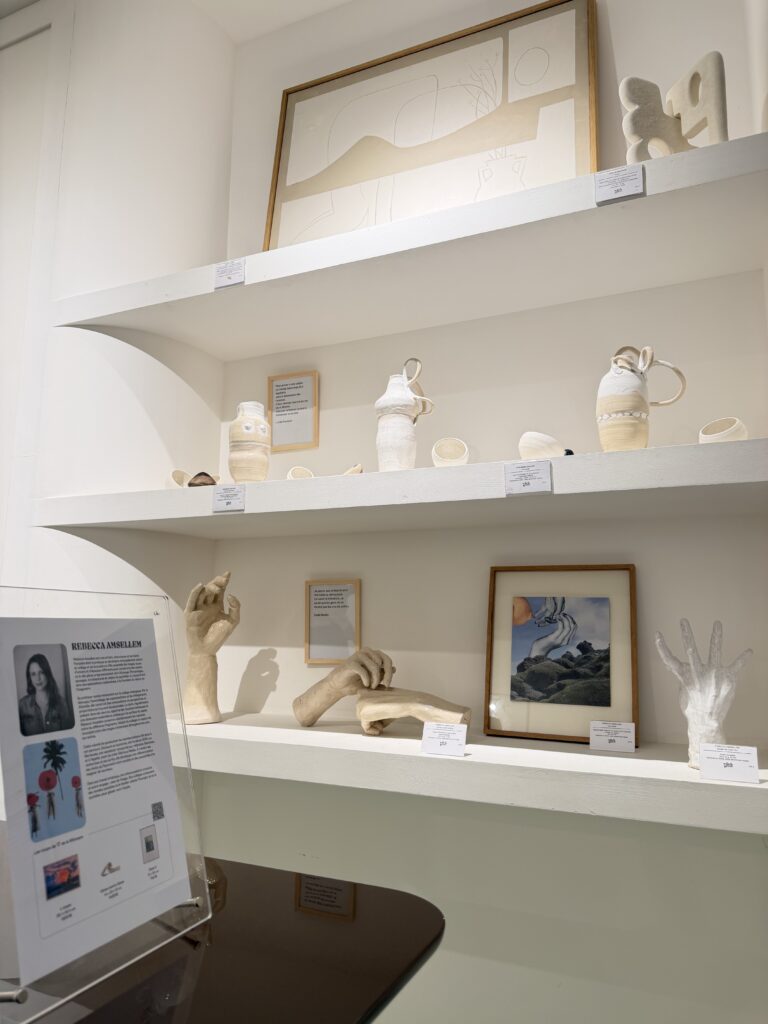
Over the years, Amsellem’s conversations and the question at the heart of the project have produced a collection of responses, which artists and writers have turned into physical pieces. The exhibition therefore feels less like a single vision of a feminist future than a collection of possible ones.
Amsellem contributes several collages of her own. They have a wonderfully assembled quality, with fragments of photographs, blocks of colour and different textures sitting together in ways that are recognisable without ever quite forming a familiar scene. The effect is dreamlike, as though you are looking at pieces of a world that has not been fully built yet, the pieces leaving enough space for the viewer to imagine what might exist beyond the edges, completing the picture for themselves.
That makes collage an apt medium for the exhibition. Amsellem is not trying to illustrate a fully formed utopia. Instead, she builds one from fragments. The pieces feel provisional, which makes them more interesting. They suggest that the future being imagined here is not a finished destination but something that could still be put together differently.
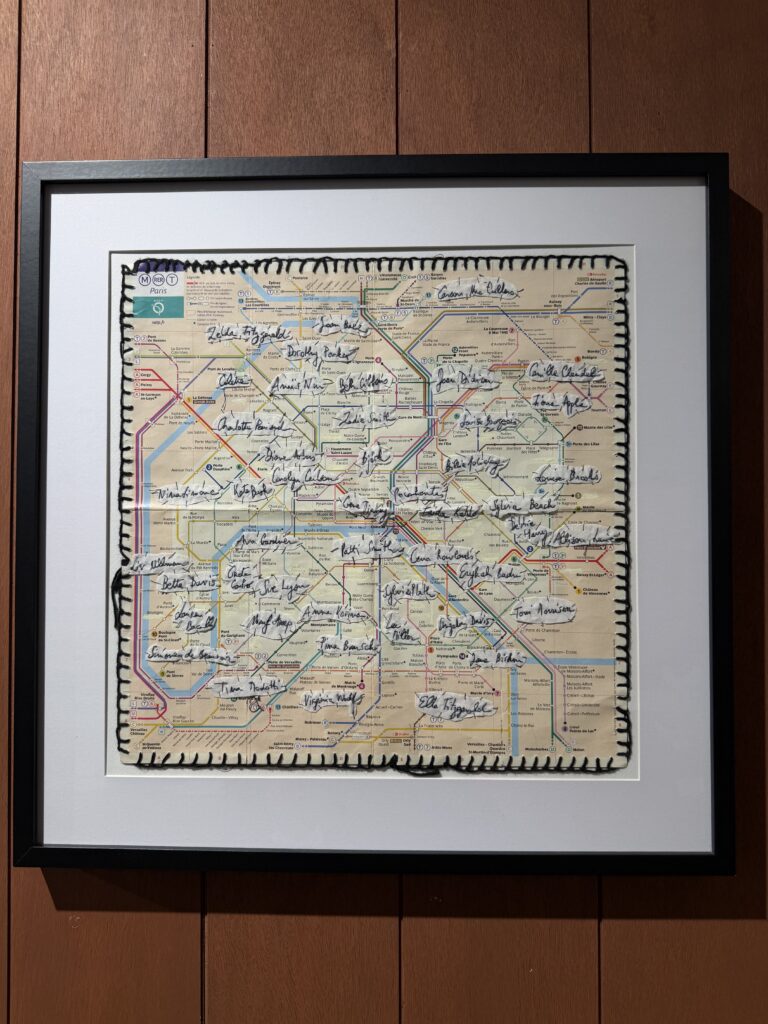
Audrey Demarre’s She Is Not There takes a more literal approach to the question of who gets to occupy public space. The work consists of the names of famous women embroidered onto a map of the Paris Metro. Demarre began with a striking observation: among the many stations in the capital, only two are named after women, Louise Michel and Marie Curie. Even Marie Curie shares her station name with her husband, Pierre.
Demarre responds by filling the map with women who are largely missing from the city’s geography, despite having made an impact on its people. The names range from Pina Bausch to Joan Didion, bringing figures from art, literature and culture into a network of places that Parisians encounter every day.
The choice of embroidery matters, too. Traditionally associated with domestic work and with forms of making that have often been dismissed as decorative or feminine, embroidery is used here to mark out space and demand attention. The tiny stitches turn the Metro map into something else entirely, an artwork that demands to be read, considered, and given space within the realm of ‘high art’.
What stays with you about La Dernière Question is how often the exhibition returns to imagination without treating it as something frivolous. Imagining a different society can sound abstract, especially when the problems being discussed are so firmly rooted in everyday life. Here, though, imagination becomes a practical exercise. If we can picture the small details of a different world, perhaps we can also start to notice which details of the present we have simply learned to accept.


