










Does preference for submissive practices in bed make me less of a feminist?
As a true enthusiast of sex knowledge, I read a lot about sex, pleasure, and sexual relations. My most recent read is Want, a collection of women’s sexual fantasies from all over the world by Gillian Anderson. I am halfway through the book now, and there is already a second fantasy that starts with something like: “I consider myself a feminist, but I can’t help but enjoy submission or even humiliation from a male partner in sex.”
The first time I came across such a formulation, I felt an alarm beeping in the back of my brain — just like when I see work emails from women colleagues starting with an apology before bringing up a valid point. It felt self-enforced and unnecessary. The second time I saw it in the same collection of fantasies, I was perplexed — why do these women feel like they first have to clarify that they are, in fact, feminists, as if it is contradictory to the sex preferences they are about to share?
I went online and found numerous blog posts, threads, and commentaries expressing similar sentiments, which made me think of what could possibly make all these women feel conflicted about their kinks and political statements. Being an adept of sex-positive feminism, I was struck by this contradiction.
For me, feminism has always been a source of power; it was a liberating force allowing me to own my pleasure, to claim it, and to never apologize for or shame myself or others for any kinks or practices — as long as they were enthusiastically consensual, of course.
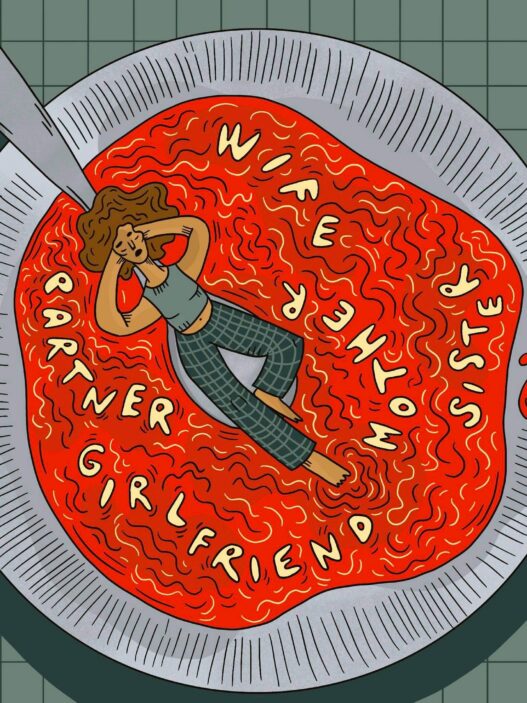
It reminded me of how, a bit over 50 years ago, Andrea Dworkin, American radical feminist writer and activist, raised a question that we are still looking for the answer to: Is any sex under patriarchy always an act of submitting to a man? In her famous work Intercourse, Dworkin repeatedly used the word “possessing” to describe heterosexual sex, highlighting the male partner’s social and physical advantages. While Dworkin illuminated real inequalities, I can’t help but notice how it echoes in the background of many women’s sexual attitudes today — the nagging sense that submission might signal complicity rather than choice.
Luckily, decades of sex-positive feminist thinking have taught us that not only is heterosexual intercourse not ideologically wrong, but it might actually be a source of reclaiming female pleasure. And now we are stepping to the next level of this discussion — where not just “regular heterosexual-in-the-vacuum” sex is questioned as a feminist-worthy act, but the submissive scenarios of it.
Power Play vs. Real Power
My wild guess would be that it is to blame on cultural scripts and misconceptions surrounding feminism. A great deal of these conflicting feelings might stem from the cultural scripts that frame submissiveness as weakness or even internalised oppression. Anticipating social judgment, women shield themselves with “I am a feminist, but…” unconsciously policing their own desires. Yes, if we dissect this contradiction without attention to context, submissiveness to men and being a full-time feminist do not seem to match very well at first glance.
Because if feminism teaches you one thing, it’s that you should not be in a position where you are “lesser” than a man. In every area — work, family, sports, hobbies, education — we, women, fairly want and deserve equal opportunities and equal treatment. But is it any different when it comes to sex?
Yes and no. No, because obviously women want equality there too, and in the sexual dimension, equality means safety and freedom of self-expression. So logically, just like in any other area of life, being equal in sex is a fair demand.
However, sex is one of, if not the most, complex matter of human lives. What seems to be the simplest natural act, in fact, has multiple layers: emotional, physical, psychological, social, relational, the list may go on and on. That is why it is so difficult to regulate sex but at the same time it is what makes it a perfect space for an exploration, a play, a pleasure seeking experiment. In this context, yes, sex is a different matter and the power play in sex is not driven by a blind submission to patriarchal norms but is evoked by desire and linked to gaining pleasure from it.
What is more, the roles on the temporary sexual playground are rarely, if ever, reflective of real power dynamics between partners in a consensual sexual act. Tender or rough, planned or spontaneous, delicate or intense – no matter what the approach, roles, or practices we go for in the act — we want them to be carried out in a safe space with a partner we can trust, just like any other sexual activity. It is about a play in a controlled environment. And what is a more controlled and safer environment than a fantasy?
As we know fantasies do not follow moral or social rules and yet, even while fantasizing, women evidently do not feel entirely free to indulge in their desires without the need to explain themselves.
What Does Science Have to Say about Sex and Submission?
A brief online research quickly revealed that submission is in fact not at all a rare sexual preference. According to Jason Lehmiller’s recent study with over 4,000 participants, power play, BDSM, and rough sex take second place among the most recurrent scenarios of fantasizing Americans of all genders, notably 61% of women in this study reported fantasizing about it and 24% — often. The honour of first place in the list of fantasies in that study goes to multiple-partner sex, which also, in many scenarios submitted by the participants, overlaps with a kink for submission. Hence, the takeaway of this study is that submissive practices, whether in our fantasies or actual sexual experiences, are not at all uncommon — quite the opposite. If we think about it, power exchange play has always had its admirers and maintained a fair level of popularity for ages.
Modern sexology gives many reasons as to why many people find it exciting: release of control for some, longing for vulnerability for others. Some use it as a way to heal from trauma by replaying the scenario in a consensual and controlled setting; others crave discipline and structure and want to let go of the leading role — at least in the bedroom. Other studies blame pop-culture in the ongoing popularity of (near-)BDSM practices, which also seems to be a valid point. Porn is available at the click of a button, and with movies and TikToks portraying BDSM elements, the sheer level of exposure naturally shapes and ignites sexual curiosity.
Control, Taboo and the Freedom to Want
These might all be valid explanations of the origin and nature of the kink for submission but what I think is an important ingredient of most kinks, power exchange included, is the feeling of taboo.
It’s possible that the perception of submission as a “feminist no-go”, shaped by societal expectations of what a “proper feminist” should do, actually adds to the taboo and makes it more enticing.
Wanting to do what you are not supposed to may and often does feel very exciting, and if we follow that logic, a misconception of feminist framework is what might be making the forbidden fruit even more attractive.
I also find it very curious that the common denominator of every woman’s story on the topic I’ve found online was control. “Submissive partner is actually the moral controller” writes one of the women, sharing her submission testimony online. Whether it was about the feeling of reversed control or the freeing moment of loosening the grip while being taken care of, in either way, control seems to be a crucial element of liking and indulging in submissive practices. That seemed perfectly valid to me. After all, female sexuality was suppressed for centuries — it is only natural for many of us to shape our kinks around control, because that is what we have been craving since the beginning of history; if we think about it, the freedom we gained is still very young and fragile. We are still not free from slut-shaming, the level of responsibility for the consequences of sex with an unreliable partner is far from equal for men and women, and let’s face it, there is still a lot of room for improvement in the department of women’s sexual and reproductive rights. So I think it is almost our duty as feminists to exercise this freedom — to do whatever the hell we desire and do it unapologetically.
After all, knowing what you like and going for it — what could be more feminist than that?
Written by Lina Pazdnikova.
Lina is a Prague-based independent author and aspiring sex educator with a degree in gender studies and a lifelong fascination with how we talk about sex. A full-time dog mom. Big fan of 8h of uninterrupted sleep.
Illustrated by Gizem Öğüt.
Gizem is an illustrator and creative professional based in Istanbul. Her practice explores themes of feminism, LGBTQIA+ rights, and resistance to patriarchal systems through a socially engaged visual language. She also produces creative content across art and fashion, integrating visual storytelling with contemporary cultural perspectives. You can see more of her work here.