


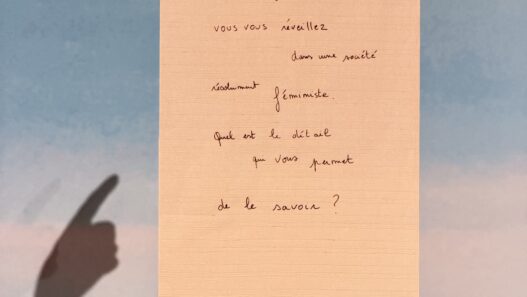




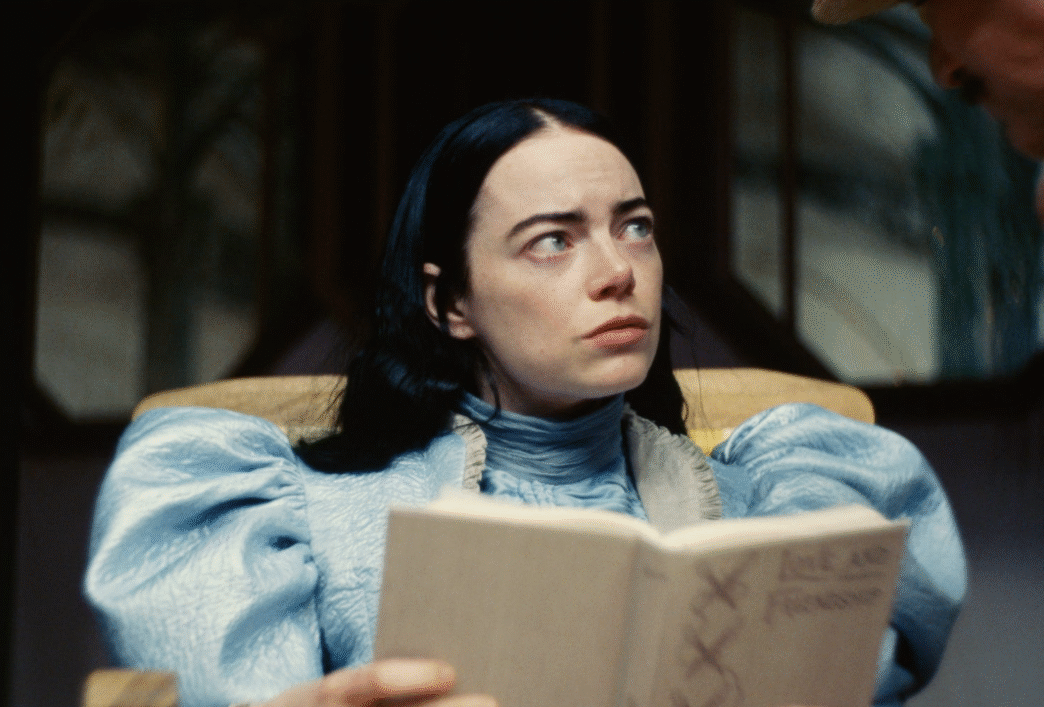
Angry women. Women who isolate themselves. Women who have obsessive thoughts, make destructive decisions, or reject societal expectations.
Such women are often defined in literature primarily through their deviation from the socialised norm: as hysterical, crazy, dangerous, or unfeminine. Today, a new category seems to have been established for them: the “weird girl.”
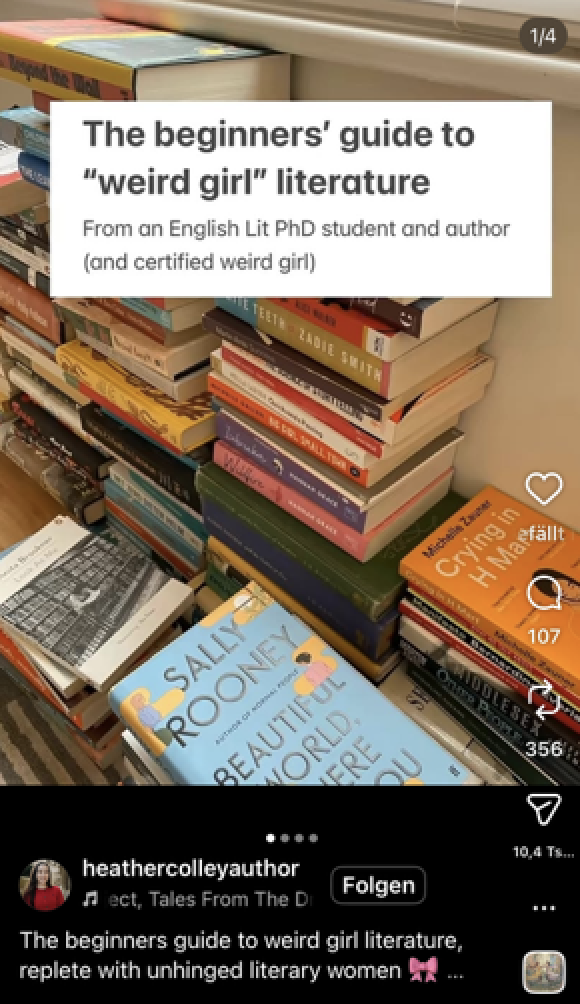
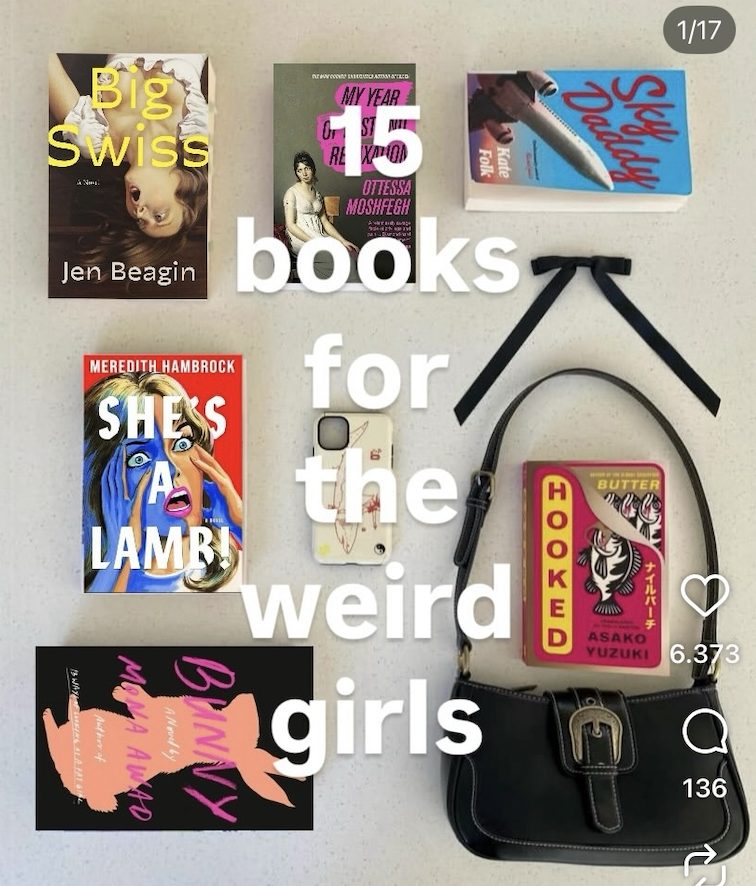
On social media, “weird girl lit” has developed into its own literary aesthetic. Under hashtags such as #weirdgirllit, #weirdbooksforweirdgirls, or #strangeweirdgirls, entire worlds of book recommendations open up, promising readers novels that are “so fucking odd, they left me thinking: ‘WTF did I just read?!’” The protagonist of a “weird girl” novel appears to represent a liberation from heteronormative female character models. She is not always likeable, not always morally clear-cut, and not designed to further the development of a male character. She is not a “Manic Pixie Dream Girl,” not a mysterious muse who rescues a male protagonist. She is not a Femme Fatale whose sexuality is framed as threatening. She exists with her own contradictions.
Yet this is precisely where the central ambivalence of this figure lies. Is the label “weird girl” actually an expression of a feminist departure from traditional representations of female subjectivity, or is female deviance merely being translated into a new, consumable category?
The BookTok Effect

Let’s consider where this contradictory attraction to nonconformity, to the “weird,” comes from, and why is this particular hype able to flourish? In his essay, BookTok: A Narrative Review of Current Literature and Directions for Future Research, Jeroen Dera discusses patterns of book consumption and recommendation on TikTok. Some of the concepts he addresses are relevant to understanding the popularity of so-called “weird girl books.” He draws on the concept of a “bookish identity”: BookTok – the TikTok-based sphere of book recommendations and literary niches – brings together people for whom books are a central part of their identity. Although Dera does not explicitly address the “weird girl” trend, his discussion of belonging is nevertheless relevant. His arguments point to a paradox: through BookTok and other social-media-friendly book recommendations, even “weirdness” – the individual feeling of not belonging – can itself become a form of belonging.
Dera also addresses the attention economy that shapes BookTok. Through the logic of imitation and repetition, labels such as “books for weird girls” can make the “weird girl” appear as an established literary category in its own right. The term reduces complex narratives to a suggestion of who is at their centre, what atmosphere a book conveys, and what emotional experience it promises.
Its popularity also lies in the fact that the label is perfectly suited to the logic of the platform: it translates complex forms of female experience into an emotional, identity-forming, and algorithmically recognisable category. According to Dera, BookTok reviews are strongly shaped by emotion and affect. Rather than evaluating books primarily on the basis of their formal or stylistic qualities, users demonstrate what a book has done to them and what feelings it might evoke in other readers. This affective reading experience, often presented as authentic, in turn enables users to identify with one another. Dera’s analysis of BookTok and its algorithmic logic may therefore also help explain why “weird girl” literature has generated such widespread enthusiasm and demand. The category offers readers a recognisable identity through which they can understand both their reading preferences and themselves. In this sense, the promise of being different becomes paradoxically compatible with the desire to belong: individual alienation is transformed into a shared cultural identity.
Embodying the Trope
In thinking about how the “weird girl” might be shaped into a consumable aesthetic, we inevitably need to talk about the “male gaze”. In her influential 1975 essay, Visual Pleasure and Narrative Cinema, Laura Mulvey describes the so-called “male gaze.” In traditional visual narratives, women are staged as objects of looking; their appearance is constructed in ways that frequently embody projections of male fantasies, while men remain the active subjects and bearers of the narrative: “A woman performs within the narrative, the gaze of the spectator and that of the male characters in the film are neatly combined without breaking narrative verisimilitude.”
Although Mulvey’s analysis refers to film, it can also be applied to literary characters. Many classical female archetypes function through their relationship to a male center. According to the study Analyzing Gender Bias within Narrative Tropes, tropes are not merely narrative conventions; they also contribute to reproducing social ideas about gender. Female characters are more often reduced to narrower, more stereotypical roles than male characters, whose portrayals tend to be more diverse and less restricted.
At first glance, the title “weird girl” seems to break with this dynamic. Her otherness does not serve to transform a man – she herself stands at the center. Novels such as Han Kang’s The Vegetarian, Mona Awad’s Bunny, Monika Kim’s The Eyes Are the Best Part, or Eva Baltasar’s Mammoth feature female protagonists whose behavior cannot easily be placed within traditional ideas of femininity.
When I read all of these books, it was precisely their complex, contradictory protagonists that fascinated me. he strength of the so-called “weird girl” lies in the fact that female characters can be written beyond likeability. They do not have to please in order to be taken seriously. I noticed in my own approach to books labelled as “weird girl lit” that I was expecting to find a kind of comfort in the scandalousness of the “weird,” and that I was curious to see what character traits I might have in common with the so-called “weird girl.”
Han Kang’s The Vegetarian, however, made it particularly clear to me why I find the genre label “weird girl” problematic. The novel tells the story of Yeong-hye, who decides to stop eating meat. This decision is not accepted by those around her as a personal choice but understood as a provocation. Her body continues to be judged, controlled, and sexualized by others. As the novel progresses, she develops a desire to distance herself more and more from human expectations.
A superficial reading might describe Yeong-hye as “weird”: a mysterious woman who inexplicably rejects social norms. Yet this perspective falls short. The crucial question is not why Yeong-hye is unusual. The crucial question is why her decision about her own body appears as such a radical deviation within her social environment.
Her “weirdness” does not emerge from a personal defect. It emerges from a society in which female autonomy is limited.
Literary scholar Fredric Jameson argues in The Political Unconscious that literary texts always negotiate social conflicts and must therefore be read within their historical context. A purely aesthetic reading can obscure the political and social contradictions that a text makes visible.
Applied to the “weird girl,” this means: if a character is read merely as unusual or eccentric, her social dimension – and, in the case of the novels discussed here, her feminist potential – may disappear from view.
The question then is no longer: Why is this woman resisting a particular order?
But only: Why is this woman so strange?
Another example is Monika Kim’s novel The Eyes Are the Best Part. The protagonist, Ji-won, develops an obsessive fantasy: she wants to eat men’s eyes. This extreme impulse is not detached from her social experience. The novel deals with misogynistic behavior, male objectification, and the fetishization of Korean American women. Ji-won’s anger is not simply a spectacular character trait. It emerges from a world in which her body and identity are constantly judged from the outside.
The label “weird” can liberate a character – but it can also reduce her once again to her deviation. Under this label, female characters are allowed to be contradictory, unlikeable, obsessive, or destructive. At the same time, there is a danger that these very qualities will once again be defined from the outside, marketed, and aestheticized.
The term appears to represent a liberation from traditional ideals of femininity. But why is there a need for a special category for female characters who are complex, irrational, or morally ambiguous? Male characters have been allowed to possess these qualities for centuries without requiring a category of their own.
Jean-Baptiste Grenouille from Patrick Süskind’s Perfume is obsessive, isolated, and morally disturbing. Patrick Bateman from Bret Easton Ellis’s American Psycho is violent, narcissistic, and deeply alienated. No one would invent a genre such as “weird boy fiction” to group these characters together.
The marketing of very different novels under the label “weird girl” risks reducing political conflicts, such as patriarchal violence, bodily autonomy, or structural misogyny, to a consumable aesthetic of female eccentricity. At the same time, feminist anger and resistance are individualized rather than understood as reactions to structural oppression. For me, the feminist potential of these literary figures does not lie in the fact that they are “weird.” It lies in the fact that they cannot be reduced to a single characteristic at all.
Written by Anna Katharina Breitling
Anna Katharina Breitling, born in 2002, grew up in Düsseldorf (Germany) and studied Political and Social Studies in Würzburg, where she is now pursuing her goal of becoming a political journalist and actress. Alongside her academic interests in feminism and human rights, she is passionate about literature, painting, and theatre. She spends her free time reading, writing – having been published in Literarische Blätter and by Pigeon Publishing, among others – and acting (in Theatre Ensemble Würzburg).
All pictures belong to their rightful owners.