








If you grow up wanting to sing, act, or model, you learn very quickly that where you are changes how seriously people take you. The farther you are from cities that matter, the easier it is for ambition to sound unrealistic until you finally leave.
That is why Adéla’s Ain’t in LA landed so well. Released on July 23 as one of the singles from her debut album PRIMA, the song doesn’t pretend location doesn’t matter, as Adéla herself left Slovakia to pursue opportunities abroad and is now based in Los Angeles. It does, however, push back against the idea that interesting lives and real possibility only begin once you reach the “right” city.
The places we learn to dream from
The song draws on the moment when Adéla came across a photograph of her mother at 18, standing in front of Western pop-culture posters her grandfather had smuggled into communist-era Czechoslovakia. It made her think about women having dreams but never receiving the kind of attention she is now getting. Teen Vogue has since described the song as an “immigrant anthem”, a song about wanting more without seeing home as something embarrassing to outgrow.
Before its official release, Adéla uploaded a video to TikTok with the caption “Can’t always be LA, someone has to hold it down in Bratislava, Slovakia“. The format spread, with people using the sound to show other less-glamourized places of their own. The joke worked because the feeling behind it was easy to recognize: sometimes the place everyone tells you to escape is still the one that made you who you are.
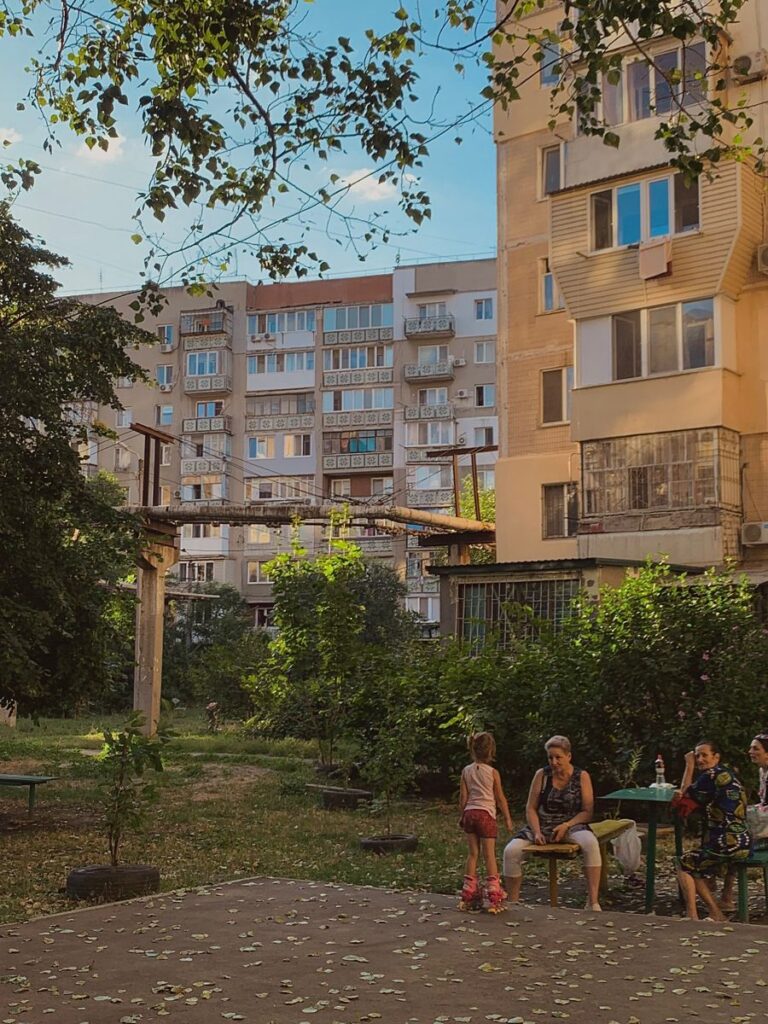
Growing up in a small town in Slovakia myself, I understood why that struck a nerve. I did see women from this part of Europe in global culture; I just did not often see the life around me reflected in them. Panelák courtyards (communist-era apartment blocks), buses which only run twice a day, summers at grandparents’ houses, the jars of preserves kept in the cellar, hand-me-down clothes, and the mixture of boredom and closeness that comes from growing up somewhere small.
This is where the line between representation and fetishization gets blurry
I recently came across a TikTok that linked Adéla with Polish Love Island UK winner Julia Majchrzak, describing them as Slavic women “finally receiving the recognition they deserve“. This statement sparked a discussion in the comments. While some agreed with the video, many others questioned the premise altogether. “Have Slavic women not been the face of the model industry?” asked one comment, with over 3,000 likes. Another, with more than 6,000 likes, said: “as if y’all ain’t the beauty standard“.Both reactions make sense as Eastern European women have hardly been absent from global fashion.
So the disagreement raises a better question than whether Slavic women are “recognized enough”: what kind of recognition are we talking about?
One comment captured the tension, saying that Eastern European girls had always received attention, but that she had never seen a Slovak pop star, actress, or model who was famous worldwide. A region can be highly visible as an aesthetic whereas its individual countries and ordinary lives remain much harder to see.
Adéla herself has spoken about that tension when she was asked about the fetishization of Eastern European women in a 2025 Hunger interview. She said it was something she thought about often, connecting the sexualisation of Slavic women to the male gaze while also defending her own right to sexual self-expression. The difference between choosing how to be seen and being reduced to what others expect to see sits at the center of this conversation.
It is especially obvious on social media. The online image of the ‘Slavic doll’ features long hair, heavy makeup, fur coats, and a highly polished beauty standard. A related “Slavic girl diet” trend has claimed that buckwheat is a supposed secret trick to staying thin, prompting women from the region to point out how little the fantasy matches their real lives. Online, “Slavic” often functions less as a precise cultural category and more as a general aesthetic label, bringing together very different Central and Eastern European identities into one recognizable image.
Katharina Wiedlack, a media scholar, has stated that even the category “Eastern European” might lead people from very different backgrounds to be blended together into a stereotypical group believed by many to have the same physical and personal characteristics.
The problem is not that being associated with beauty is automatically insulting, or that women who fit the image represent the region incorrectly. It starts when a narrow version of beauty becomes the main way outsiders recognize an entire group. A 2008 meta-analysis by Shelly Grabe, L. Monique Ward, and Janet Shibley Hyde reviewed 77 studies and found small-to-moderate links between exposure to thin-ideal media and outcomes such as body dissatisfaction, internalization of the thin ideal, and eating-related beliefs and behaviors. That does not mean every glamorous stereotype has the same effect, but it helps explain why an apparently flattering ideal can still feel restrictive.
So yes, an Eastern European supermodel on a Vogue cover is a representation of a kind. But she cannot stand in for every woman from the region: a teenage girl in a village, a queer woman, a mother, a factory worker, an older woman, or anyone whose life and body do not fit the region’s most exportable image.
What happens when home gets to stay in the frame
This is where Ain’t in LA comes back in. Adéla is glamorous, conventionally attractive, and now works in the global pop industry. She has left home, and Los Angeles has progressed her career. What the song does differently is refuse to turn Bratislava into a footnote in a story about getting out. Her Slovak background is part of the song’s point and part of its visual setting.
That is also why the trend traveled so easily beyond Slovakia. People were not simply posting where they lived. They were taking places usually treated as peripheral and putting them at the center of the frame for a few seconds.
The point was never that Bratislava offers the same opportunities as Los Angeles. It was that a place doesn’t have to become the next LA to be worth seeing.
Maybe that is a more useful way to think about representation too. Not as a headcount of famous women, but as the range of lives that get visibility. For girls growing up far from the places usually treated as the center of everything, that matters. Sometimes seeing yourself does not mean finding someone who looks exactly like you. Sometimes it is simply seeing a place like yours on screen and not being told it is only the place you are meant to leave.
Written by Michaela Skalová.
Michaela Skalová is a writer based in Slovakia, where she studies linguistics and media. She contributes to a student magazine as a writer and graphic designer, with interests in culture, social media, art and whatever catches her attention in between.