







A student is too ashamed to ask for a menstrual product and goes home instead. Another improvises a pad out of toilet paper. A volunteer remembers hearing about a girl sent to boarding school with a single pack of pads expected to last her an entire semester.
These experiences reveal how period poverty can take different forms.
For years, the issue has remained largely invisible in Romania, where menstruation is still treated as something private and shameful. Pe Stop and Iele Sânziene are the only two organizations in the country focused specifically on period poverty and menstrual equity. Through direct distribution, menstrual and sexual health education, and advocacy for free products and better public policies, they are approaching period poverty as a problem of access, dignity, and rights. 
The unequal cost of menstruation
Period poverty is a global issue that affects people who menstruate but cannot afford menstrual products or cannot access the basic hygiene infrastructure needed to manage their periods safely and with dignity. Across Europe, an estimated 10% of people who menstruate experience period poverty, according to a recent European Parliament report. Those most at risk are people with a low income, refugees, young people, and people with disabilities.
The inequalities are even more pronounced in Eastern Europe, where studies show that people have to work up to three times longer to afford menstrual products, compared to those in Western Europe.
Romania illustrates these inequalities particularly well. 27.4% of people in Romania are at risk of poverty or social exclusion, compared to the EU average of 20.9%. A 2026 study by Pe stop Association found that 41% of the 1558 respondents earning less than the minimum wage had struggled at least once to afford menstrual products. Among them, 12% said they had resorted to improvised alternatives when they couldn’t access the products needed.
This habit of improvisation can be traced back to a long history of menstrual stigma and inequality in Romania.
During the communist period (1947-1989), menstruation was treated as something private and shameful, even though women’s reproductive lives were closely monitored and controlled by the state.
This became particularly pronounced after President Nicolae Ceaușescu introduced Decree 770 in 1966, which banned abortion on request and access to contraception in an effort to increase the birth rate. Menstrual products were unavailable because they weren’t produced domestically or imported, and only a small number of women from the upper class could access pads or tampons through personal connections. Until the early 1990s, when disposable menstrual products became available on the Romanian market, most women relied on cotton wool, which offered little protection. During the severe economic austerity of the 1980s, even cotton wool became scarce and was often of poor quality, forcing many women to improvise with pieces of cloth or by wearing multiple pairs of underwear to prevent leaks.
While today’s challenges are different, the inequalities have not disappeared. Romania entered a technical recession at the end of 2025, meaning the country’s Gross Domestic Product (GDP) dropped for two straight quarters. Combined with tax increases and salary cuts, the economic downturn has put additional pressure on already vulnerable communities. In this context, access to menstrual and hygiene products risks becoming even more limited for those already struggling.
“We didn’t start with the idea of founding an association, we just wanted to help other women”
Until Pe Stop [On Stop – a name referencing the Romanian colloquial expression for being on your period, “being on stop”] was founded in 2018, no Romanian organisation focused exclusively on tackling period poverty..
Its founder, Irina Vasilescu, had been volunteering since she was a teenager and had spent her professional life working in the nonprofit sector. The idea for Pe Stop came almost by chance, when she came across a story about a young woman in the United States preparing menstrual hygiene packs for women experiencing homelessness. It made her wonder whether anyone was doing the same in Romania. At the time, no one was.
Vasilescu used some of her own money to fill a backpack with sanitary pads and went around Bucharest looking for women who might need them.
Alexandra Tănase, who would later become the association’s co-founder, soon joined her. Together with a few others, they distributed ten packs of pads to women experiencing homelessness around Bucharest’s North Railway Station.
“We didn’t start with the idea of founding an association, we just wanted to help other women”, said Carmen Bulac, advocacy specialist at Pe Stop.
What began as a small personal initiative quickly grew. The group launched a crowdfunding campaign to continue the distributions and raised 19 times more than their initial goal, showing there was public interest and support for addressing period poverty. From there, they organised menstrual product collection drives in cafés, libraries and other community spaces, eventually growing into Pe Stop Association.
Since then, the initiative has grown into The Dignity Network, which now operates across 24 counties in Romania. Over 50 volunteers help ensure that 1.600 people who menstruate receive period packs every month.
During the last weekend of every month, a team of volunteers from Bucharest gathers at Pe Stop’s storeroom to prepare personalized “dignity packs”, taking into account the sizes and preferences of beneficiaries. The packs don’t contain only pads or tampons, but also hygiene products, antibacterial gels, and underwear. The products come from direct donations from companies that produce them, or they are purchased by the team.
After the packs are ready, another team of volunteers distributes them in the communities where they are needed. The communities are extremely diverse, from disadvantaged urban communities, rural communities, and marginalized communities like those at Pata Rât [Cluj’s landfill, home to about 1.500 people, including Roma, Romanians, and Hungarians] to communities in women’s detention centers, refugee centers, and schools for children with neurodivergent conditions.
“We don’t search for a homogeneous social category; we go where people need us. A representative from a community usually applies to receive help from us. They can be a teacher, a social assistant, or someone directly from the community”, said Bulac.
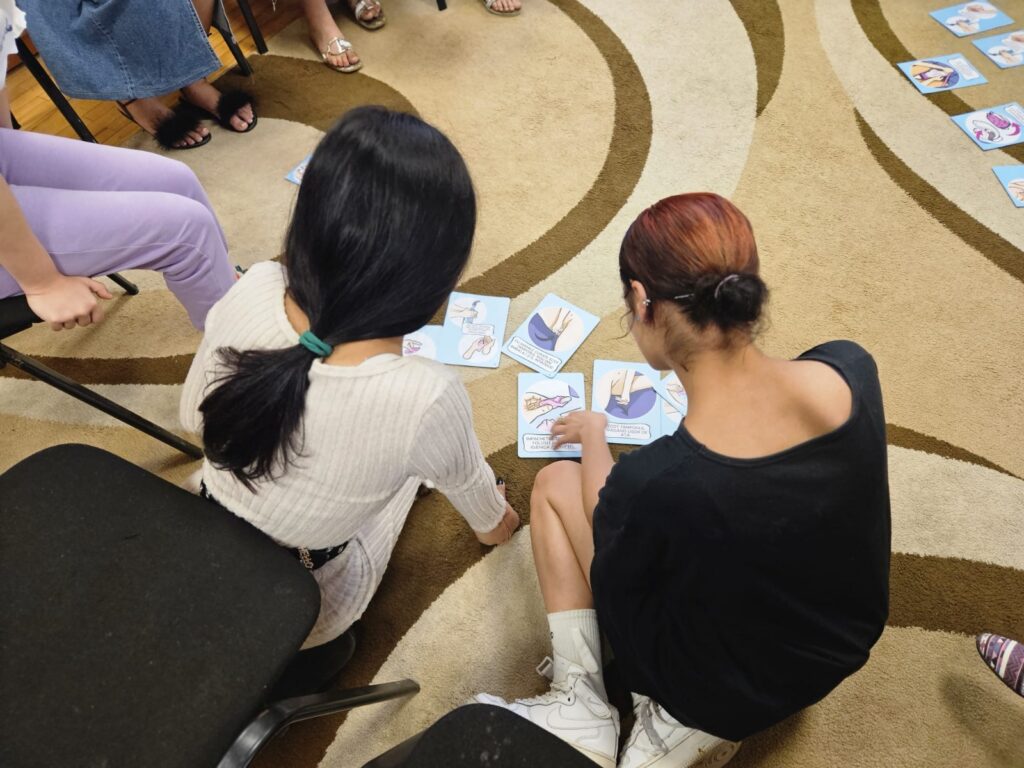
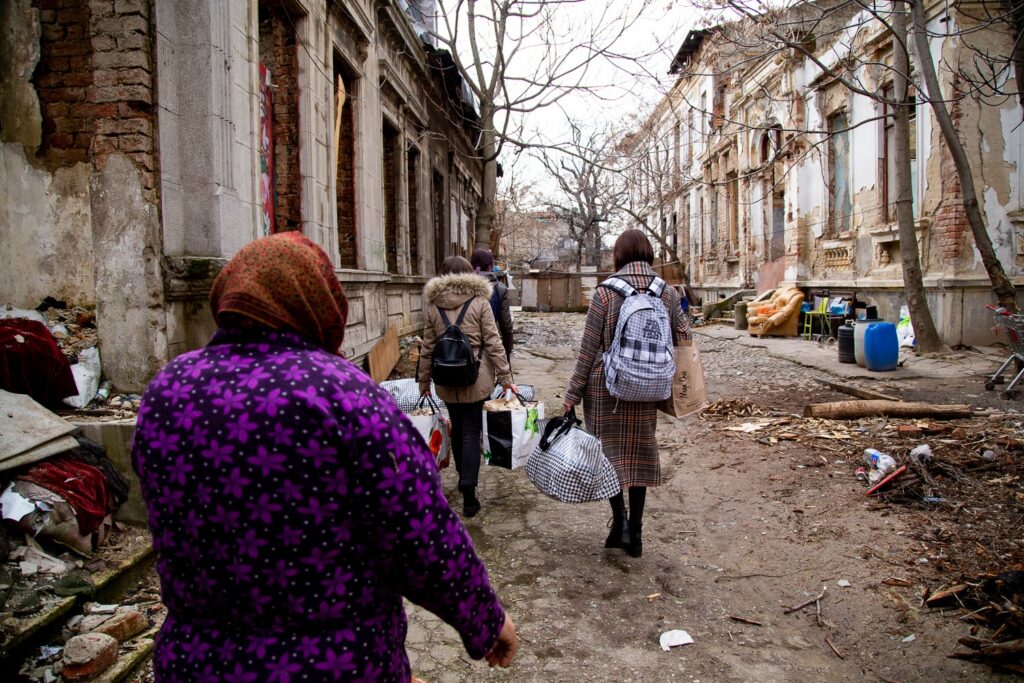
Photo credits: Pe Stop.
Period equity: the topic avoided by public policies
In 2019, Iele Sânziene was founded by Ioana Ciuhan, who had already spent several years working with young people in Romania’s nonprofit sector. At 21, she travelled to Tanzania with an AIESEC volunteering project, where she noticed how little information teenage girls had about menstruation. The experience took her back a year later, this time for six months and with a project of her own, running menstrual education workshops and distributing reusable pads.
While Ciuhan was still in Tanzania, friends working in Romanian NGOs and informal groups who had followed her work online began inviting her to hold similar workshops in their communities. She created the Iele Sânziene Instagram page before she had even returned home, and the association followed in early 2019.
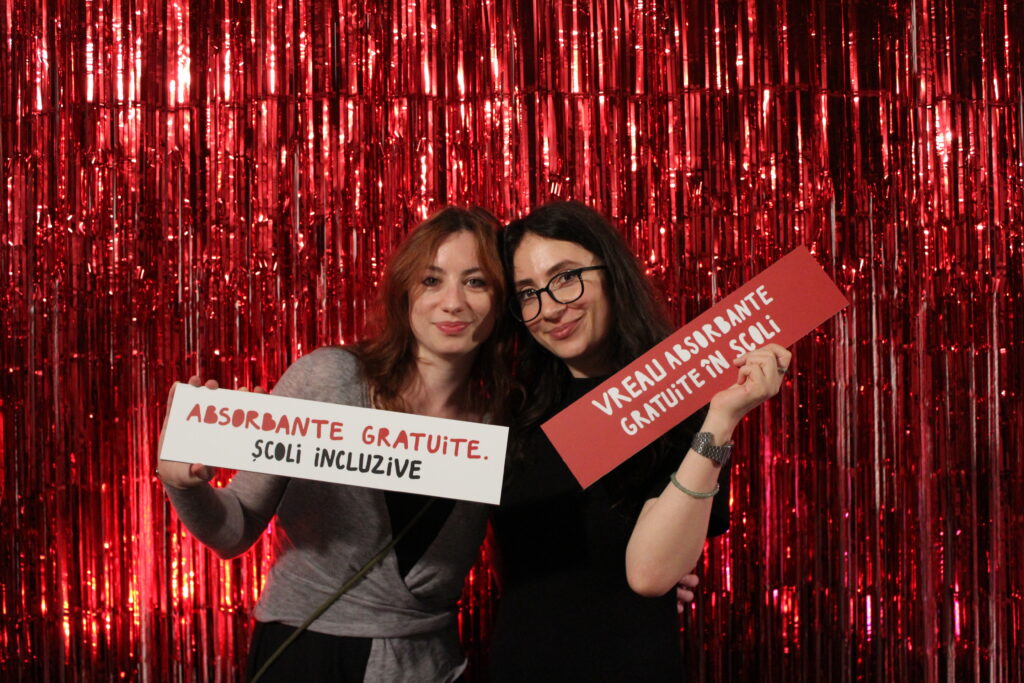
Photo credits: Iele Sânziene.
The name Iele Sânziene comes from Romanian folklore, bringing together the good Sânziene fairies and the darker, rebellious Iele. The Iele are often pictured dancing together in a circle, an image that reflects the sense of solidarity and community the organization wanted to create.
Like Pe Stop, Iele Sânziene also started with direct distribution of products, but quickly decided they wanted to focus on advocacy.
“We do advocacy because, first of all, pads and tampons are expensive. Second of all, the problems related to menstrual hygiene and education are absent from public policies. Menstruation doesn’t exist in the strategies for health, for education or for gender equity. We don’t have anything to address the menstruation plan”, said Oana Constantin, vice president of Iele Sânziene.
In Romania, periods are still treated as an individual responsibility, reinforced by the stigma surrounding menstruation, so schools, workplaces, and other public spaces are not expected to provide pads or tampons.
The team advocates for period equity, a broader approach that goes beyond ensuring access to menstrual products for the most vulnerable people. It means creating the conditions for people to manage their periods safely and with dignity, from access to affordable products and adequate facilities to menstrual education and health. Much of Iele Sânziene’s work focuses on young people, encouraging them to understand their rights and giving them the tools to advocate for change in their schools and communities.
“The phenomenon is much more widespread than we tend to think. It doesn’t only affect people in extremely vulnerable situations. Many people have struggled at least once to afford menstrual products. Menstruation can easily fall to the bottom of your list of priorities when you have other expenses to cover. You might still be able to buy pads, but you may have to choose the cheapest option rather than the product that is comfortable or works best for you. You are still affected by period poverty, even if, technically, you have pads in your bag”, explains Constantin.
Political momentum, limited change
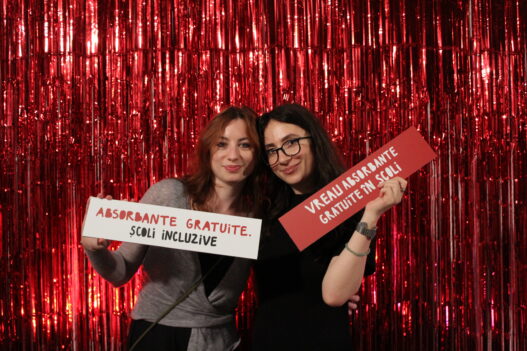
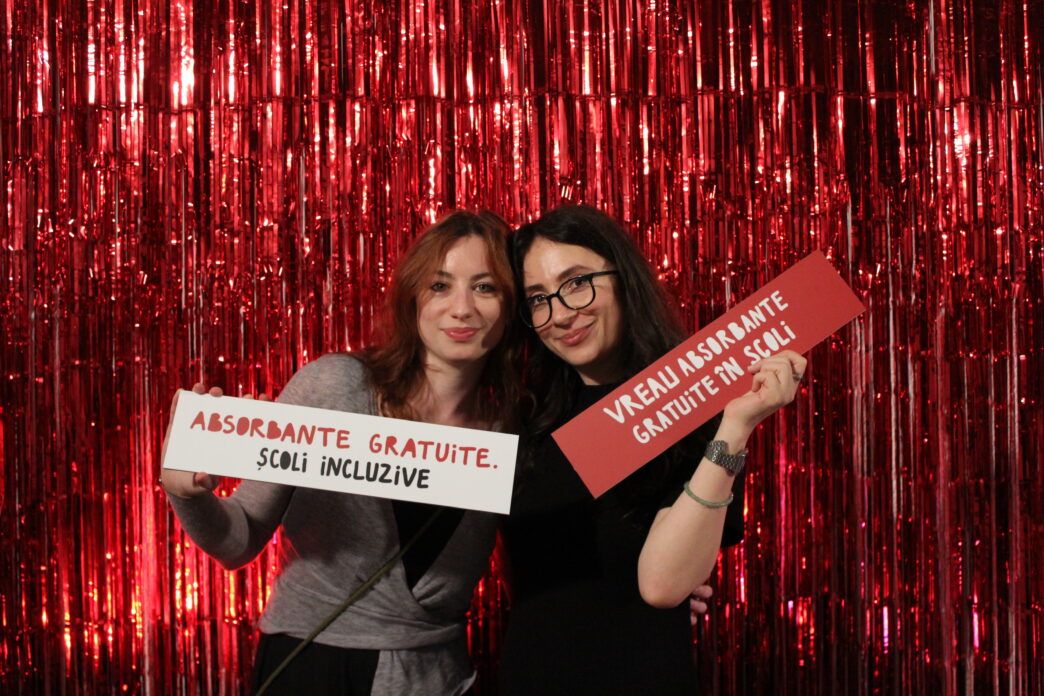
In 2021, they launched the Petition for Free Sanitary Pads in Schools, which collected 43.205 signatures. The petition started a movement: a chain of events in the political sector, lots of news coverage, people talking about the subject online. Everybody started to pay more attention to menstruation.
After this petition, Iele Sânziene and Pe Stop joined the “Together for Girls” Working Group established in the Romanian Parliament by MP Oana Țoiu. Together with several other civil society organizations, they took part in consultations aimed at developing a legislative proposal to address period poverty in Romania.
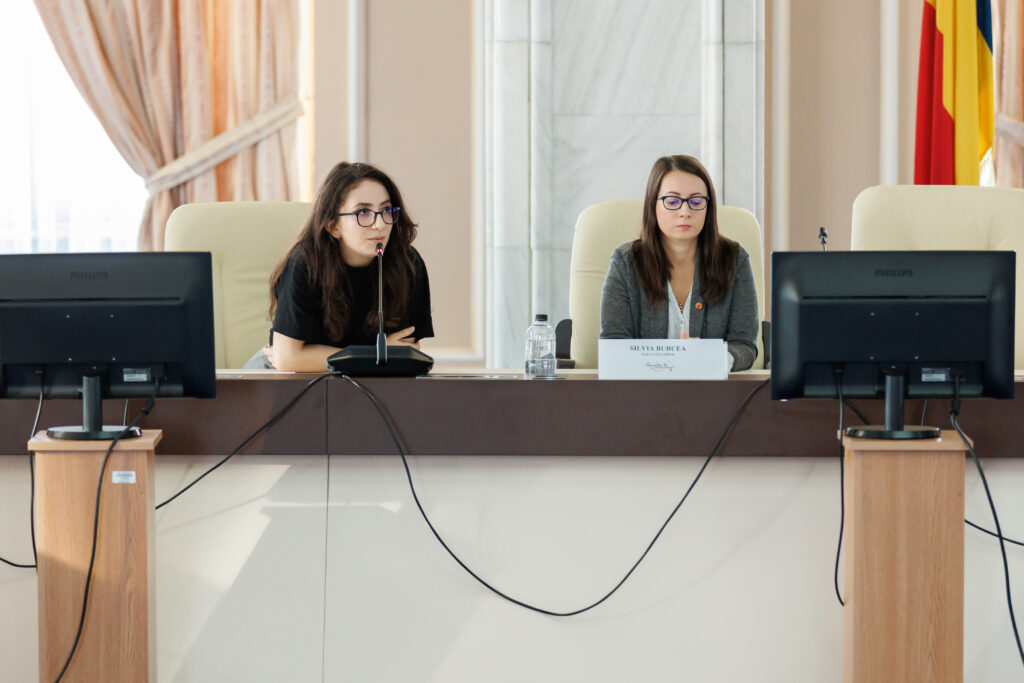
Photo credits: Iele Sânziene.
Following these consultations, PL-x No. 372/2021 was submitted to Parliament in September 2021. The legislative proposal aimed to support young women from disadvantaged backgrounds and people experiencing homelessness by providing financial assistance for hygiene products. Five years later, the bill has still not been adopted.
However, two pilot projects did emerge from the political momentum created at the time, in Bucharest’s Sectors 3 and 6. Local councillor Nina Costea in Sector 3 and deputy mayor Mihaela Ștefan in Sector 6, consulted with Iele Sânziene and Pe Stop to bring free menstrual products into schools. Both initiatives were adopted through Local Council Decisions, securing public funding for the projects. Sector 3 installed around 600 dispensers, while Sector 6 installed 15.
The two pilots became important proof that menstrual products could be provided through local public budgets, creating a model that advocates could take to other local councils across the country.
But they also exposed the limits of turning a good policy into practice. Although both projects technically remain in place, dispensers are not always restocked. In Sector 3, the local administration also purchased token-operated dispensers, despite Iele Sânziene recommending free-access ones, undermining the very principle of unrestricted access behind the initiative.
“The projects themselves are incredible, but the implementation is not very good at the moment,” Constantin said.
Pe Stop also wants to lean more into the advocacy component of its work, so this summer the organization launched a small volunteer program dedicated to this.
Learning about women’s health
Another key component of the work carried out by both organizations is education.
“We don’t see period poverty simply as a lack of access to menstrual products. It also means lacking access to information, knowledge and menstrual health education. It’s not only about the financial or material poverty people usually think of. Knowledge is also a crucial part of it, especially when it comes to menstrual health”, said Carmen Bulac.
Pe Stop offers two types of courses: “Menstrual hygiene”, which is a 2-hour introductory course about menstruation, menstrual hygiene and health, the cycles and phases of the menstrual cycle, and “Body and Consent”, a 5-hour course about sexual education and body dignity.
The courses were created in collaboration with doctors, sexologists, and teachers, and they are personalized depending on the age of the participants, being taught from schools to city halls. The courses are taught by the central team and volunteers who have previously participated in Pe Stop training sessions, where they learn how to facilitate, how to interact with others, and the course material itself.
Iele Sânziene also holds menstrual and sexual education workshops in schools, alongside programs that teach young people about menstrual equity, sexual and reproductive rights, and how to advocate for change in their own communities. Through their Period Justice Now program, young people have already started their own initiatives, often through local Student Councils. In Ploiești, for example, students surveyed their peers about access to menstrual products and used the results to show there was a need in their communities, with some taking their findings further to school inspectorates or local authorities.
But neither association can reach every school or community that asks for support, so both have developed ways to extend their work beyond their own teams. While Pe Stop trains volunteers across the country to deliver its courses, Iele Sânziene has created free resources that teachers, youth workers and students can use independently. These include a menstrual equity toolkit with ready-to-use activities and materials for organizing workshops, as well as guides and resources that help young people and educators advocate for menstrual equity in their own schools and communities.
Funding remains the main limitation for initiatives tackling period equity
“Teachers and people from different communities often contact us asking to hold workshops in their schools, but we simply don’t have the funding to reach all of them. We keep these communities in mind when we apply for grants and try to include them in future projects”, said Oana Constantin.
Funding remains one of the main challenges in expanding this work. Pe Stop relies on individual and corporate donations, as well as partnerships through which companies provide menstrual and hygiene products, while Iele Sânziene largely relies on project-based grants. This means that the funding determines where they can go and what they can do.
Advocacy can be even harder to fund. For instance, Iele Sânziene’s campaign for free menstrual products in schools initially had no dedicated funding. The work itself is also difficult to quantify, as much of it happens behind the scenes, through emails, meetings and conversations with public officials.
#MenstrualMattersEU and replicating these models beyond Romania
Pe Stop and Iele Sânziene are part of #MenstrualMattersEU, a European network launched by several organizations that tackle period equity. The network is now formed of 18 associations from 12 European countries.
“It helps us a lot because we realise we are not alone, other organizations are dealing with the same kind of work and problems,” Bulac said.
It also offers a chance to see how similar solutions can be adapted to different communities. In Slovakia, for example, InTYMYta’s Dôstojná menštruácia project provides free menstrual products through “period cabinets” in schools and community centres. When professionally manufactured cabinets proved too expensive, the organization created an open-source manual so communities could build their own, with some vocational schools even making them during carpentry or metalwork classes.
At the same time, the exchange offers a reality check: while organizations in some European countries are already focusing on the environmental impact and sustainability of menstrual products, in Romania the priorities are still more basic, with many communities lacking consistent access to menstrual products, water, and adequate sanitation.
Sharing solutions across borders also highlights a broader limit: organizations can respond to gaps, but “we cannot take the place of the state,” Bulac said.

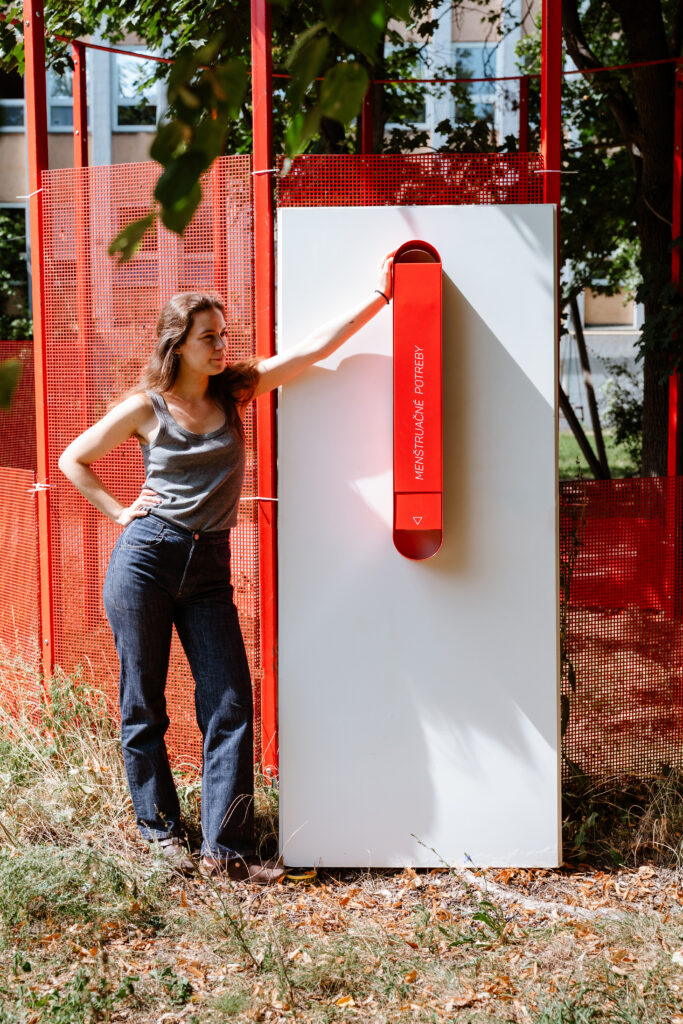
Photo credits: Dôstojná menštruácia, Magdalena Hlatka.
Over the past few years, period poverty has become harder to ignore in Romania. Pe Stop and Iele Sânziene have brought menstrual products into communities and schools, opened conversations around menstrual health, pushed the issue onto the political agenda and given young people tools to advocate for change themselves. Yet much of that progress still relies on the work of a handful of organizations, volunteers and local allies. For menstrual equity to become the norm, the state will eventually have to take on more of that responsibility.
Written by Daniela Vasilache.
Daniela is a Romanian journalist with five years of experience covering health, science, and social issues. She is particularly interested in women’s health and in stories about people and communities whose experiences are often overlooked. In 2025, she received the Feature Writing/Longform award at Superwritings, Romania’s leading journalism awards, for her story on the psychological impact of IVF treatment.