






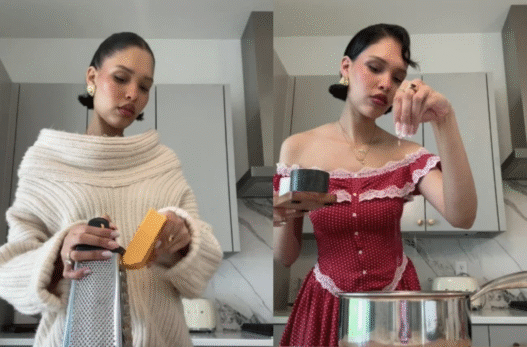
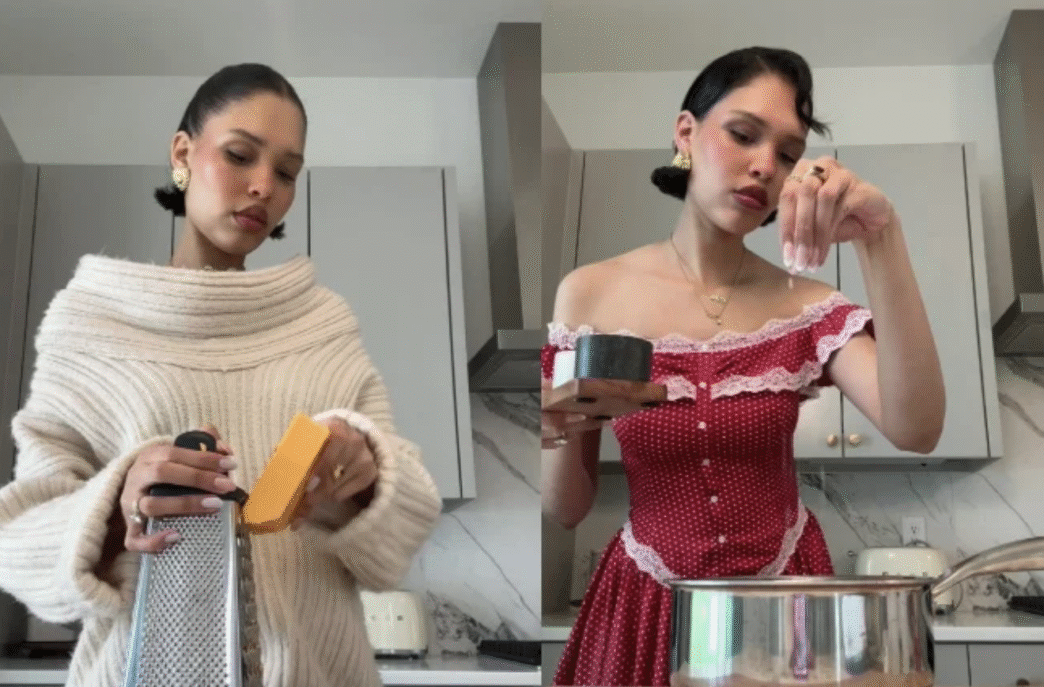
In the summer of 2022, just three days after the U.S. Supreme Court overturned Roe v Wade, which launched a new era of attacks on reproductive rights, Vice President JD Vance took to X. He said, “If your worldview tells you that it’s bad for women to become mothers but liberating for them to work 90 hours a week in a cubicle at the New York Times or Goldman Sachs, you’ve been had.” Not so coincidentally, the same rhetoric was leaking into TikTok, where influencers such as Hannah Neeleman and Estee Williams were standing in their kitchen in vintage dresses, with recipes in hand, showing their audiences that being a traditional American wife and homemaker was, actually, good fun.
This ‘tradwife’ content continued to grow alongside the rise of the right, and in 2024 a new creator entered the discourse. Model and influencer Nara Smith first rose to TikTok fame after posting a video of her making bread and peach jam from scratch at her toddler’s request. The video saw over 18 million views and marked the beginning of a new style of ‘tradwife’ content creator. Nara’s style was very much similar to Hannah Neeleman and Estee Williams – the kitchen workbench was her stage and she made food at the request of her family – but she amplified each component; vintage dresses worn were worth thousands of dollars, ‘from scratch’ recipes reached a whole new convoluted level (bubble gum, Snickers bars and even toothpaste), and a sultry voiceover was added to each video. By the end of 2024, she had quadrupled her followers and packaged a brand.
Living in the grey area
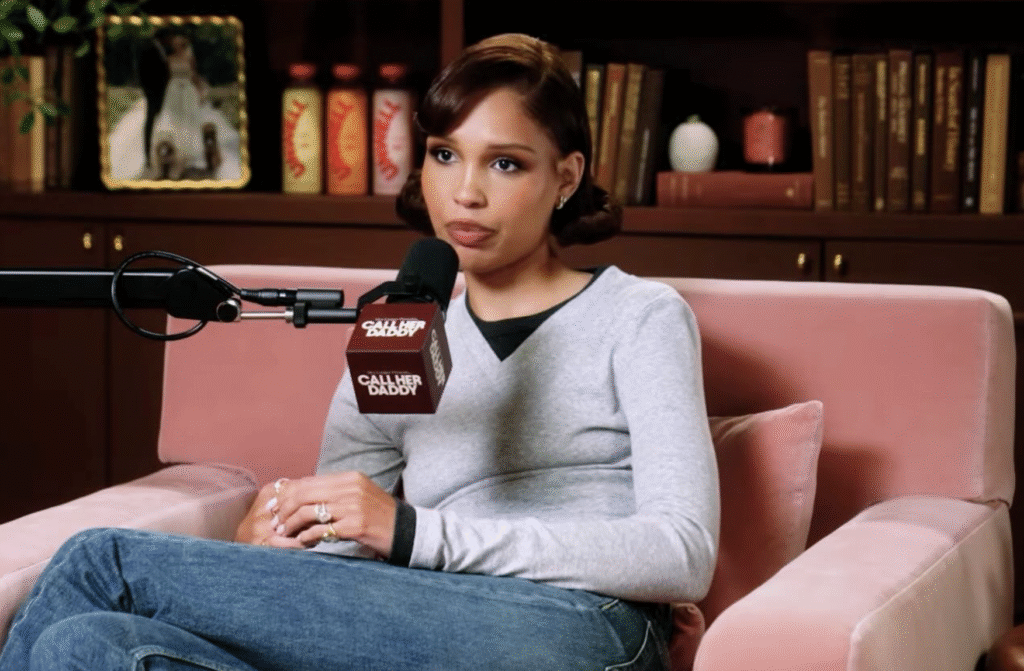
In July, Nara Smith was interviewed on Call Her Daddy podcast, where she spoke about her rejection of the ‘tradwife’ label that she felt was thrust upon her. She explained that the similarities with her style of content were completely incidental and, whilst she has tried to correct the narrative, she accepts the misunderstanding: “I feel like I don’t mind being in the grey area. I’ve kind of detached myself from what the public perception is because I know I’m not that.” At first glance, this is understandable. The job of influencers is to hop, skip, and jump on trends to capitalise on their popularity. Smith has built an empire from her kitchen table, and all she needed was a whispering voice and an ungodly amount of ingredients – why should she have to be vocal about her views? The issue is the nature of the trend she jumped on. The ‘tradwife’ term was born out of a meme which circulated 4chan, a popular forum for incel culture, and the popularity of tradwife content has always existed in tandem with the growth of alt-right and Christian nationalist discourse.
Whether creators realise it or not, the tradwife brand serves as a cosplay of political ideology. While most trends don’t bring with them hugely dangerous side effects – I don’t think anyone has suffered from drinking copious amounts of matcha or spending thousands on Labubus – the viewers of tradwife content toe the line between enjoying the aesthetic and falling for propaganda.
The tradwife as a fantasy
But why do women enjoy tradwife content? A report produced by the Global Institute for Women’s Leadership asked women to rate how appealing they find aspects of the tradwife lifestyle. Over half of respondents stated “a relaxed, calm, low-stress lifestyle” as very appealing, and over 60% stated “luxurious lifestyle/affluence” as either somewhat appealing or very appealing. This is really no surprise. As author of Yesteryear, Caro Claire Burke put it, “the bill of goods that a lot of modern women were sold didn’t feel to be working out. You know it’s really hard to have it all. It’s really hard to afford childcare in America, let alone to work and be with your kids in any meaningful way.”
Given that America is currently experiencing a ‘child care crisis’ where mothers are struggling to support their children whilst maintaining employment, it’s no wonder why aesthetics such as ‘fairy core’, ‘cottage core’ and tradwife content have gained popularity. They romanticise a simple life which offers women the time, energy, and money to eat less processed foods, wear beautiful outfits, and be present in their lives.
By incorporating these fantasies, right-wing media exploits women’s discontentment to push the false promise of a ‘better’ life onto them.
Many have critiqued the view that tradwife content influences its audience’s political views, and, if you were to watch some of Hannah Neeleman’s and Nara Smith’s videos, you might agree. It’s cooking from scratch, nice clothes, and a woman who loves her family. However, when you stir in the political discourse, the picture changes. A young girl who enjoys a video of Nara Smith making cereal from scratch may soon find her algorithm suggests content from another tradwife creator, Estee Williams. Although the style of her videos looks the same, a few scrolls up from watching her make homemade potpourri, the girl will find Williams talking about the importance of traditional gender roles, women as homemakers, and the nuclear family. A few scrolls up from that, and she’ll find Williams’ stance on abortion: “innocent life should NOT have to pay for the sins of others.”
A Charles Sturt University study on teenage girls’ experience on social media found that “the girls are heavily self-regulating and conforming to certain dominant discourse in the presentation of the self, creating an opportunity where the influencers online have the power to direct and influence the girls through a call to action in the form of emulation and self-improvement.” This, coupled with the finding by Ipsos that Gen-Z males are increasingly citing traditional gender values about women’s subservience, is worrying. Whether creators believe in the ideology they are borrowing from or not, they open a door for young people who don’t know what they’re walking into.
Bringing home the bacon
As politics becomes increasingly polarised and inflammatory, it’s obvious that tradwife creators are setting up shop in the grey area to keep profiting. This is particularly the case with Nara Smith. In the interview she echoes 2010’s era ‘girlboss’ hustle culture when she dissects the definition of a tradwife and counters each point to discredit the label: “So, with that definition and those points, I’m none of that and we can go through it point by point. I don’t prioritise being a homemaker. I’m a working mom, like I am out in LA, I travel a lot.” All three of the mentioned tradwife creators have transitioned their content away from traditional gender roles and obvious right-wing views. Estee Williams stated in 2025 that she’ll be moving over to general lifestyle content, and both Hannah Neeleman and Nara Smith have tactically moved to content on running a business whilst providing for their families. For Neeleman, it’s her online farm shop ‘Ballerina Farm’ which sells farm protein powder, sourdough starters, and gingham aprons. For Smith, it’s her upcoming cookbook ‘Homemade’, ads for brands such as Marc Jacobs, and Vogue covers; the shift from tradwife to girlboss is, at its core, contradictory, given these women earned their wealth through an aesthetic rooted in an ideology which in reality would not allow them to work or have financial independence.
This isn’t about tearing women down. Women are feeling underpaid, underworked, and politically defeated, so it makes sense why these influencers ran with the content that grants them the most economic freedom. However, the goal of influencing is to influence, which is why it’s not enough for creators to live in the political grey area at the detriment of free publicity for the manosphere.
Political ideologies are not trends, and to genuinely improve women’s quality of life, gaps in policy need to be bridged. There’s no doubt that ‘the girlboss’ won’t be the last archetype of womanhood that these creators adopt in order to profit from, which is why it is all the more important that we continue to hold them accountable for the agendas that they push.
Written by Imogen Mole
Imogen Mole is a freelance writer based in the UK. She writes across culture, lifestyle, and travel.
All images used for editorial purposes and belong to Nara Smith/Instagram.