







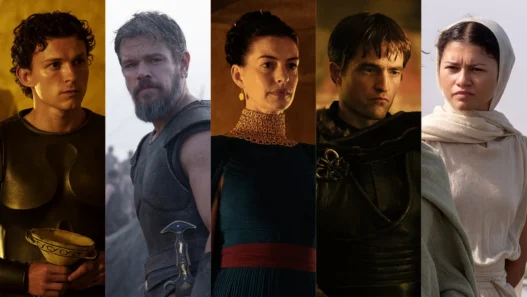
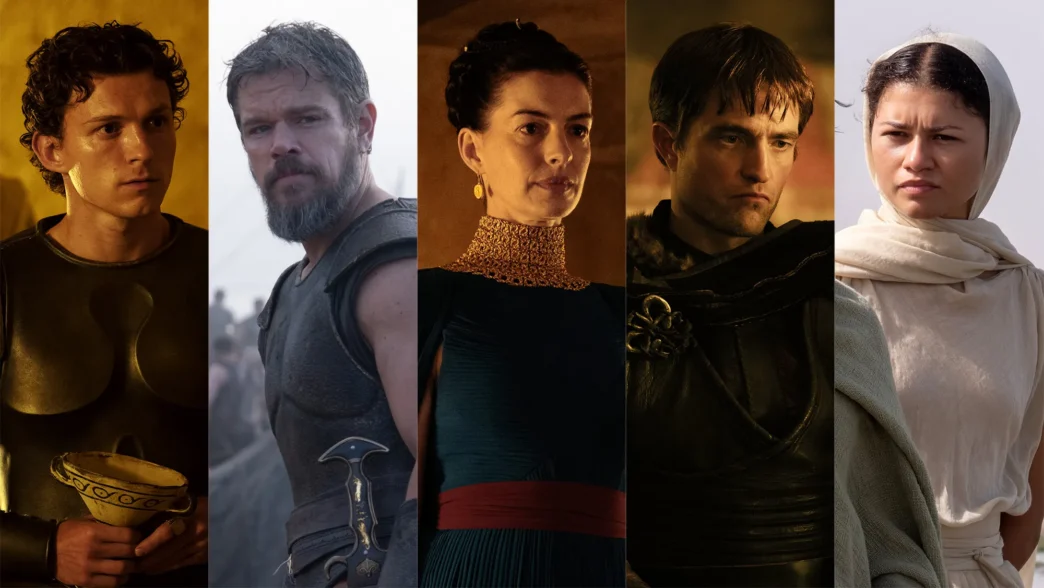
It is said that Chrisopher Nolan’s genius ends when a woman enters the frame. The Odyssey was his chance to prove that wrong. Though one of the most patriarchal stories in Western history, Homer’s Odyssey contains some of the most multi-faceted and complex female characters in literary canon. What happens to these women when Nolan gets the keys to its modern retelling?
The Odyssey isn’t only the story of one man’s journey home; it’s just as much the story of the people who aid and hinder him from his return. Many of them are women. For the past three weeks, the internet has been flooded with opinion pieces, dissecting every aspect of this blockbuster, questioning Nolan and his penmanship of female characters. 
Nolan has full license here — this is an adaptation of an ancient myth, and myths bend, depending on who is telling them. The very essence of an adaptation suggests that a film doesn’t need (and, frankly, shouldn’t be expected) to mirror its source material with the precision of a translation. Even Emily Wilson, the classicist and only woman to translate Homer’s Odyssey, expresses this in her own review of the film alongside her many gripes with his creative liberties. Nolan publicly credited Wilson’s translation as a major source for his script, which makes these critiques worth taking seriously.
Nolan proves in many cases that the liberties he takes are intentional and open up the original text to a modern audience. However, Nolan’s freedom becomes his downfall. Much like his protagonist, he fails to bring interesting and modern interpretations of these women home (pun intended).
PENELOPE
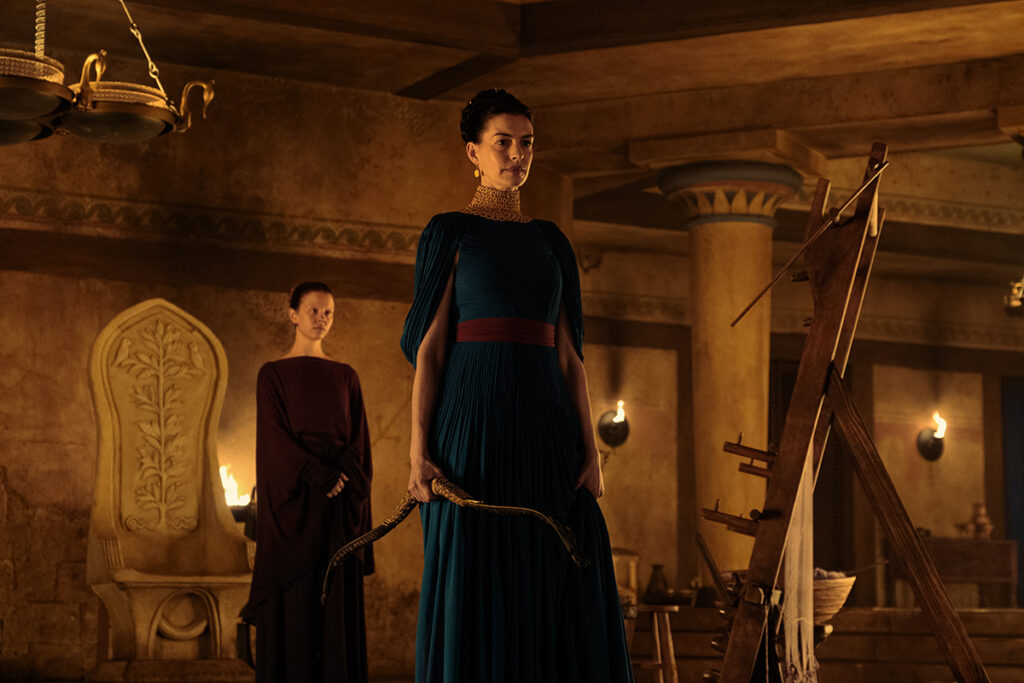
Anne Hathaway’s Penelope is rewritten as the emotional center of the film, not a woman passively waiting for a man to “make it all better” but one with agency and anger. She’s cunning, sharp-tongued, and openly resentful of a court that expects her to grieve prettily and rule invisibly.
As Belen Edwards’ review in Mashable says, if Christopher Nolan does anything with the women in this movie, he “lets them be angry”. Penelope is a great example of that. She manipulates the men who invade her space, and ultimately reaches breaking point. She is not unwaveringly loyal to Odysseus, but visibly oscillates between giving up hope and wishing for her life to return to the way it was. Her objectives feel more grounded than a passive wife and weaver. The film gives her far more respect than the original text does — seeing as Homer’s poem begins with Telemachus essentially telling her to shut up.
But respect isn’t the same as agency, and the film doesn’t quite let her hold both. Nolan lets her name the injustice — twenty years spent governing Ithaca while it still won’t call her its ruler — but he never lets that injustice cost Odysseus anything. The king comes home, reclaims the throne, and the film moves on; the credit for two decades of work reverts to the man who gets it back by right of arrival, not by having earned it.
CIRCE
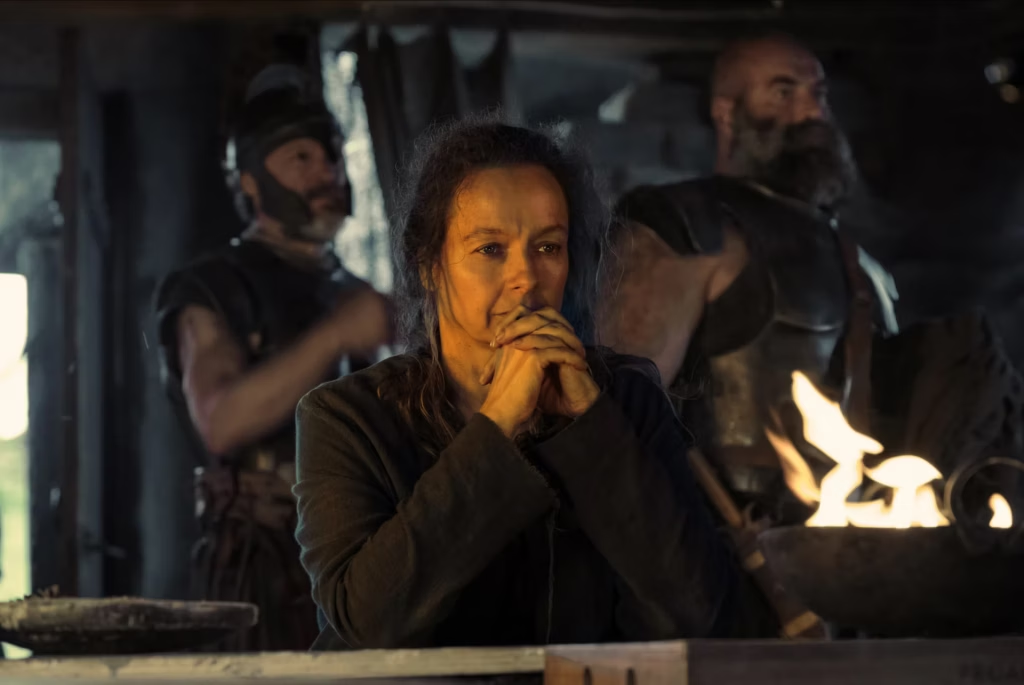
Circe is where Nolan earns some more progress points. Samantha Morton’s Circe is granted more depth than the seductress-witch from Homer’s poem pop culture seems to remember her as. Instead, she is rightfully a woman shaped by the entitlement and violence of men, not a villain simply enjoying her own cruelty. When Odysseus asks if his men hurt her, she answers by saying, “they would have” – a feeling women know all too well. Her command “go back to your disguises” gives men’s vanity and lack of self-control a literal, physical form, and the practical effects in the scene let Morton use every inch of her body: a study in a woman who knows exactly what her hands are worth. It places her more akin to Madeline Miller’s book Circe – a powerful woman who is feared by the gods. And rightfully so.
Now – unlike Miller’s masterful retelling – Nolan bottles it. When Odysseus arrives, there’s no standoff, no deal struck between equals – she simply gives in. Odysseus does not prove his wills and smarts to her – he walks in…and that’s it. He is not impressive and worthy of Circe’s respect after what we’ve just seen her do. We witness Circe as being smarter and more powerful than the men and yet we still see her fall at the knees of a pretty mediocre one. Homer’s Circe, more villainous but no less sharp, still negotiates with Odysseus as an equal; therefore, Odysseus (and the audience, by proxy) earns her help. It’s a frustrating end for the best-written woman in the movie and it says something uncomfortable about whether any of the women in this film are able to keep their power.
CALYPSO
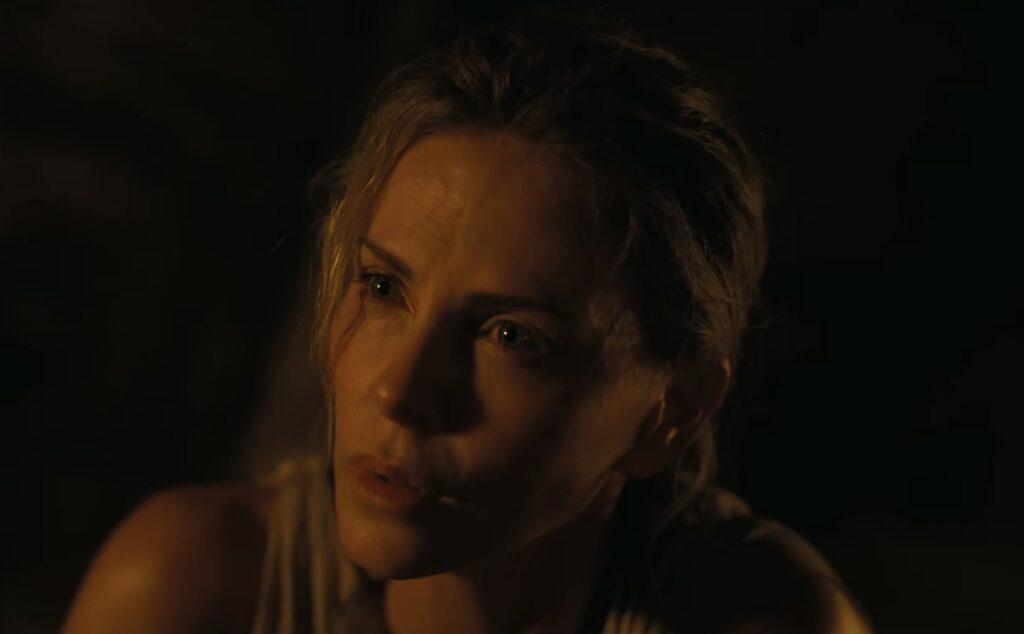
Calypso is the film’s biggest missed opportunity — a nymph and a goddess, daughter of Atlas, exiled for siding with the Titans — reduced here to a plot device. Homer’s Calypso is sharp, funny, and expresses real grievances about gender and power, even amongst gods and goddesses. As Emily Wilson says, she has a “wonderfully outraged, operatic speech about divine double standards: male gods can kidnap and rape any mortal woman they desire, but then a goddess tries it, Zeus and his cronies scupper her chances.” What makes Calypso an interesting character is that she tows the line between being a villain, a tragic figure, a narcissistic goddess and a woman who fixates, as many of us have, on an unavailable man who strings you along for years. But we don’t get to see any of that on screen.
Charlize Theron’s Calypso has none of this depth. She is not awarded the anger Nolan gives to Penelope or Circe. She’s essentially a gorgeous, glorified therapist. She is certainly not complicated and multi-faceted like the Calypso I was expecting to see: lustful, flawed, angry and full of wit. Her job is to drug him, listen to his sob story and send him on his way.
Worse, the film quietly shifts the blame. Here, Nolan’s Odysseus doesn’t decide to stay on Ogyia with Calypso as Homer’s Odysseus does. He is essentially lobotomised, putting the onus on Calypso to help him find his way back. It frustratingly lets Odysseus off the hook. In Homer, staying with Calypso for years despite a wife and kingdom waiting for him at home is proof that as much as he wants to return, part of him isn’t ready for it yet. Nolan’s Odysseus is far from perfect, but he dampens what is arguably the most important obstacle in his journey home: when presented with paradise — love, peace, pleasure and immortality — will he still choose to return?
By taking away Odysseus’ awareness, you don’t remove his agency so much as hers: she has no arc, no struggle to let him go. The only point of her character is to realise what’s best for him. Odysseus’ objective stays clean while Calypso’s motives never get the same clarity. The film blames her for delaying him without ever giving her the space to explain, or even grapple with, what she actually wanted.
HELEN & CLYTEMNESTRA
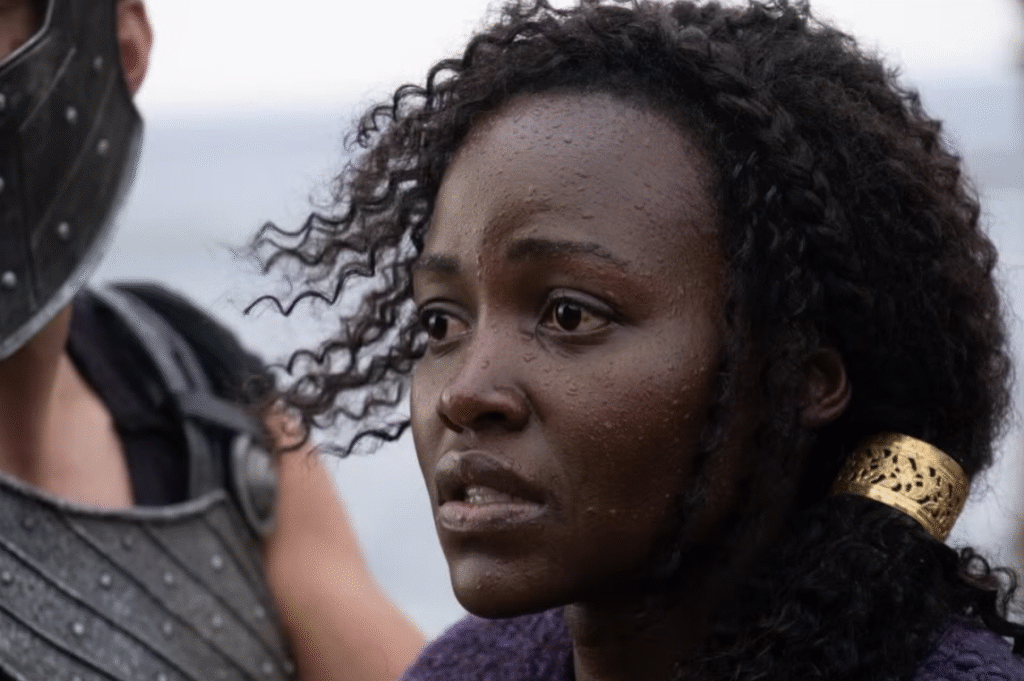
Lupita Nyong’o pulls double duty as Helen and her twin sister, Clytemnestra – two female characters with phenomenal potential for interesting arcs, especially with a powerhouse actress inhabiting them. But as Emily Wilson reviews, both are “hugely underwritten” reduced to “a set of brief tableaux of female victims” – the bereaved mother, the abused wife, the repentant adultress – across a handful of minutes.
The film does grapple with some refreshing perspectives. It doesn’t blame Helen for the Trojan War but rightfully sees her as a scapegoat for a war men chose to fight. Nolan leans into Agamemnon’s greed and treats Helen’s abduction, or willing affair, as pretext rather than cause.
It highlights that only men can have control over their own homes. Helen is the only woman in this story who sets out on a journey of her own. She leaves, and a ten-year war breaks out in her name. Ironic.
On the other hand, Clytemnestra provides us with a satisfying repercussion for prideful Agamemnon: a man who comes home expecting a hero’s welcome, badly underestimates the bereaved wife he left behind after sacrificing their daughter, and pays for it with his life. It’s a rare glimpse of what this war actually costs the women tied to it. But it’s a blink-and-you’ll-miss-it moment before you find out she was killed by her own son for her actions. Nolan frames her anger less as a reckoning and more as a bad omen for Odysseus — what could happen to him, not what actually happened to her. These women are nailed into the ground and if they try to move or take their power back, there are clear consequences.
Sympathy without screentime is cheap, and these roles barely survive the cut. Nolan doesn’t give Nyong’o nearly enough time to show what she can do. I think it shows exactly how much Nolan cares about his ‘progressive’ interpretations by how many minutes he allocates to them.
ATHENA
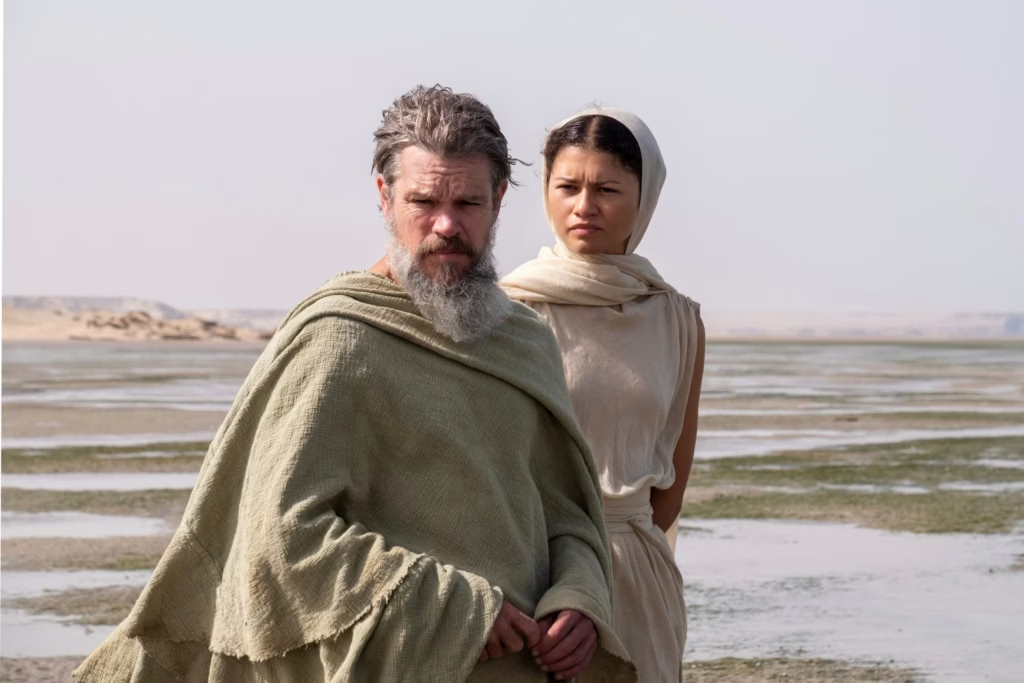
If Nyong’o is underused, Zendaya’s Athena barely exists at all. While Helen may be the face that launched a thousand ships, Zendaya is surely the face that launched a thousand press tours – red carpets and interviews about her ‘perfect’ performance – for a character reduced to a handful of scenes. Something about that feels exploitative. Her Athena is nothing more than a vulnerable stand-in for Odysseus’s conscience, not the scheming, formidable war goddess of the source material. Nolan’s Athena is calm and all-knowing as the only real god we see, but lacks any strength, complexity or prowess.
It feels as though her presence, as well as Helen’s, were seen as unimportant, and cut down to make room elsewhere. That room tellingly goes to male characters such as Robert Pattinson’s Antinous, whose subplot and backstory with Sinon takes up ample space in the nearly 3 hour film and seems to exist mostly to give Hollywood’s current golden boy character actor more air time. Though he seems to be having loads of fun as the slimy, scheming leader of the suitors, it baffled me to see him more than the actual goddess of wisdom, who is much more crucial to Odysseus’ journey than Antinous is.
Ultimately, is this the worst interpretation of women we have witnessed in a Christopher Nolan movie? Not even close (see: Emily Blunt & Florence Pugh in Oppenheimer). It’s progress. Largely because of the source material, but it is true that The Odyssey’s women are more than just a footnote.
But the question worth sitting with is whether “better than before” is the bar we’re willing to call good enough. The moments where he pulls back – Circe’s swoon, Calypso’s silence, Athena’s and Helen’s stolen minutes – all carry the same message: give women depth right up until it might outshine the men. He lets them be angry, but doesn’t actually let you see or sit with them long enough to truly care.
His liberties could have been extended to give the women of The Odyssey real narrative power, but were very clearly redirected. Where the men (servants, supporting and sidekick characters alike) are given space to develop fully formed arcs, the women are fighting to be seen and heard. Audiences are forced to derive meaning from their mere minutes, while scenes between male characters are at times painfully expositional, almost forcing you to connect with them more than the women. The women of The Odyssey are not given Nolan’s most precious commodity: TIME.
Written by Deanna Orlando
Deanna Orlando is a Canadian-Italian writer and filmmaker based in London. In addition to writing for Lazy Women, her essays and criticism have appeared in Why I Love Pink magazine and on her own Substack, Secrets From a Girl. Her films and writing explore coming-of-age, grief, girlhood, cultural criticism and the importance of female representation in media.
All images used for the purpose of reviewing and belong to their rightful owners.