







“I got assaulted Monday, and now I’m possibly pregnant. I don’t want to report him, nor see his face ever again,” reads one comment under the YouTube video
Women Tell Us Why They Didn’t Report Their Sexual Assault, which has drawn similar stories in the comments for nearly a decade. To this day, users keep sharing their experiences of sexual assault with each other. “I thought it was my fault. I also didn’t know it was rape because it didn’t happen in a back alley at night. I wasn’t threatened. It wasn’t a stranger in a mask. I didn’t report it for all of those reasons,” reads the newest comment, which was posted three months ago. That victims of sexual assault chose to remain silent is not a rarity.
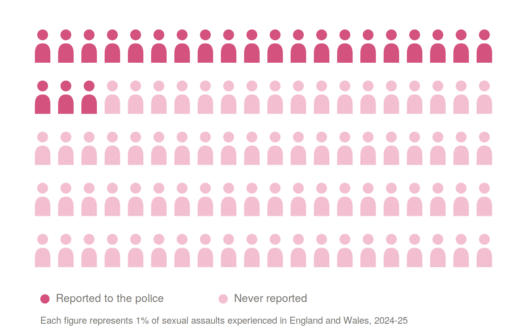
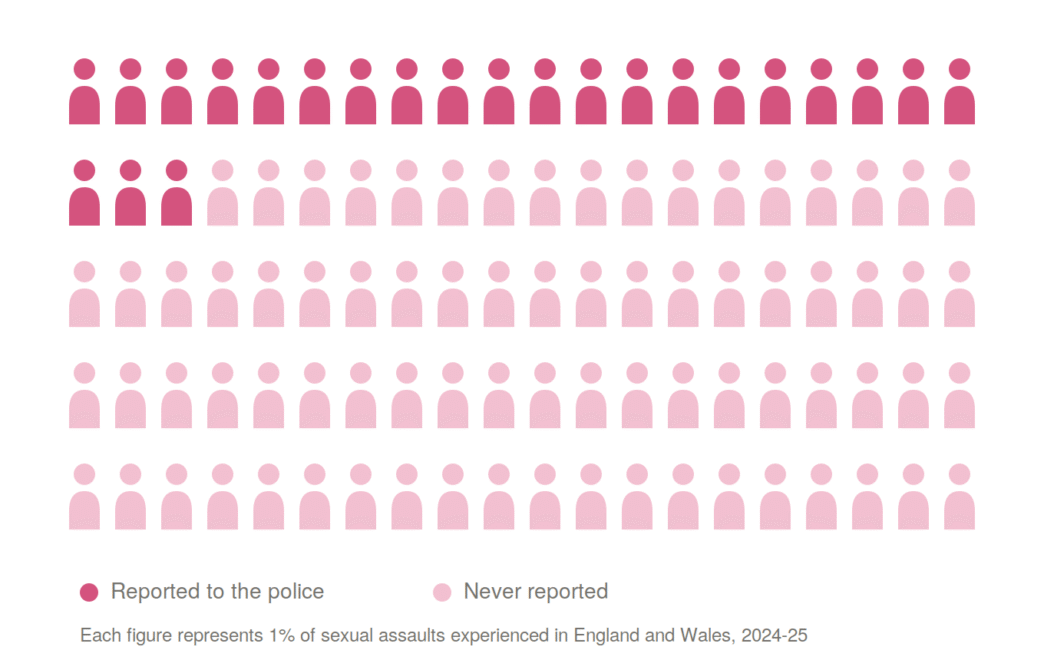
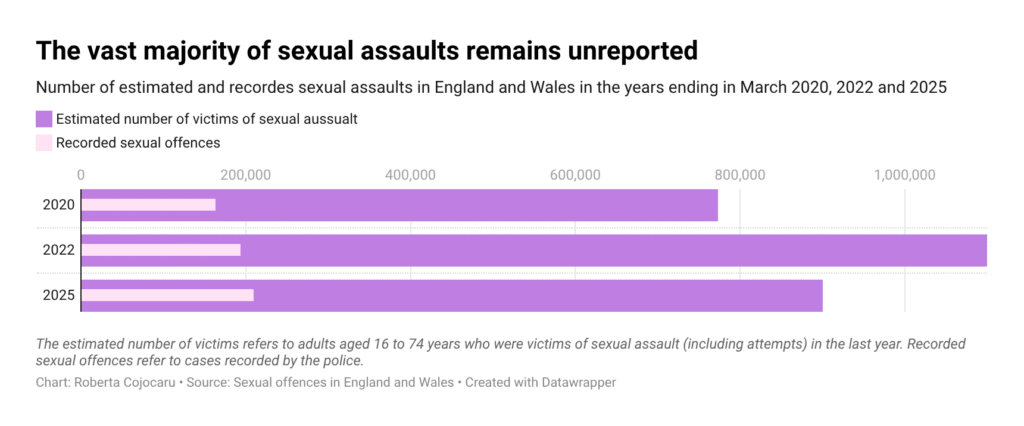
The vast majority of sexual assaults are not reported to the police
According to the Crime Survey for England and Wales between April 2024 and March 2025, around 900,000 people aged 16 and over experienced sexual assault, including rape as well as unwanted sexual touching. Some 739,000 of them were female, making up 82% of all sexual assaults. 
However, in the same year, the police recorded only 209,079 sexual offences in England and Wales. The discrepancy between experienced and reported sexual offences, often called the ‘dark figure’ of crime, results in less than one in four sexual assaults being reported to the police. The vast majority – 77% of all experienced cases – remain unreported.
Nevertheless, police and survivors of sexual assault depend on each other: police rely on reports from women to understand the underlying problem. Women rely on the police to seek justice. But what if the criminal justice system is actually one of the reasons why women choose not to report sexual assault in the first place?
Re-living traumatic experience when reporting sexual assault
“Many victims tell us reporting is worse than the initial rape itself,” says Dr Dominic Willmott, Associate Professor in Legal and Criminological Psychology at Loughborough University. “There is this idea of being re-raped by the criminal justice system,” he says. When survivors of sexual assault have to report what has happened to them, they are automatically forced to re-live the traumatic experience. This process is known as (re-)traumatisation. Due to that fear, some survivors choose to remain silent rather than report to the police. “I thought I’m better off just trying to put this behind me,” a female rape survivor explained in a study conducted by Willmott and colleagues.
Not being believed by the criminal justice system
Once survivors summon the courage to come forward and report sexual assault, they face another barrier: not being believed by the criminal justice system. “Judges, barristers and police officers have told me they think lots of the allegations are not true,” says Willmott. However, Full Facts estimates that only a small minority (3-4%) of allegations are false.
The reason for that misperception is the existence of so-called rape myths. Those are beliefs and stereotypical ideas used to justify and excuse rape. For example, believing that women wearing short skirts “are asking for it”. These misconceptions are deeply rooted in social attitudes shaped by historical norms. For instance, rape within marriage was only recognised as a crime in the UK in 1991.
The consumption of alcohol and drugs before or during the assault is often used to discredit the truth of sexual assault. “I had one survivor who was really violently sexually assaulted. And she was also intoxicated. Instead of taking her report, they took her to what is called the drunk tank to detox, making that the priority instead of the fact that she was harmed. Her circumstances discredited her,” says Dr Jodie Murphy, Associate Professor at the School of Social Work at Lakehead University in Canada.
For her study, Murphy spoke to female survivors of sexual assault about their experience of not being believed by the police and found that “making a report to the police was challenging due to the shame, vulnerability, and exposure of a disclosure.” One woman told Murphy: “They [the police] just seemed like they didn’t want to be there; they just didn’t care enough. I felt like I was burdening them and wasting their time.”
To combat this issue, Tony Blockley, Professor of Policing and Head of the School of Social Sciences at Leeds Trinity University, conducted a study and recommended embedding trauma-informed practices across the justice system. In September 2023, the college of Policing has designed a Rape and Serious Sexual Offences Investigative Skills Development Programme (RISDP) to teach police officers about sex offenders, victims’ responses to these traumatic events, myths and misconceptions about rape, communication skills, victim support, and effective response. As of May 2024 over 4,500 have completed the training, which has increased the number of arrests and convictions of sexual offenders, according to the Home Office. “Our training ensures officers are taking a victim centred approach,” says College of Policing CEO Chief Constable Andy Marsh.
The justice process spans several years
Once survivors have overcome the barrier of reporting and being believed, another problem is the criminal justice process. According to the newest report by Rape Crisis England & Wales, a survivor of rape has to wait 3 years and 229 days from the day of the offence until the case is completed at the Crown Court. While the report acknowledges that “a rape case does not begin with a report to the police – victims and survivors often need years to come to terms with what has happened to them, seek support, and feel safe and supported enough to report to the police”, it highlights several aspects that have caused the backlog in the Crown Court, one of the gratest factors being limited availability of lawyers and judges.
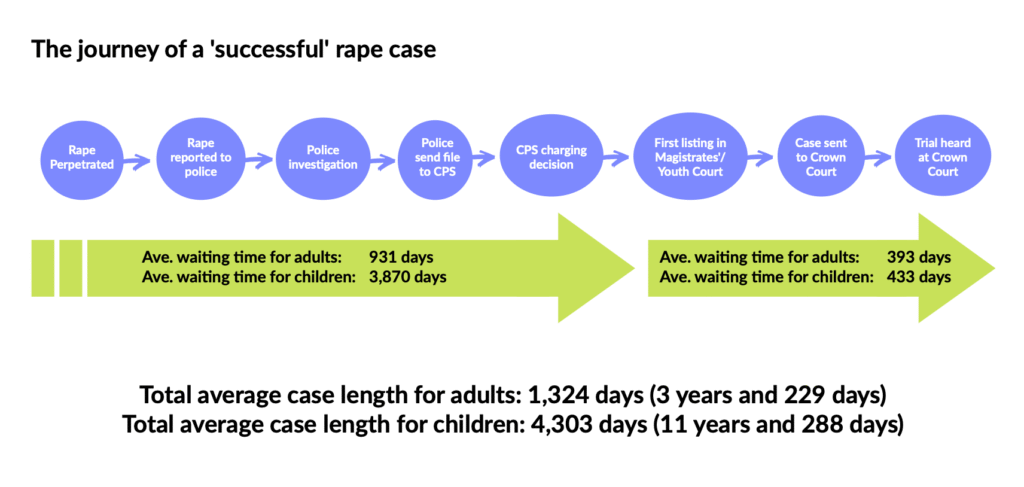
For example, a victim’s trial “had been adjourned due to one of the barristers no longer being able to make the date and there being nobody else to cover,” reports Rape Crisis. Another victim’s case shows that court room capacity can also become a problem: the victim “received news that the trial would not be going ahead as planned. She was told that there would be no free courtroom, as the Court was under pressure to absorb cases from another nearby Court, which was closed due to requiring major repair works.”
“Only 2% of all reported rape cases ever get to court. The fact that victims do not want to pursue it through the criminal justice process is because of the way they are treated within that process,” says Blockley. Consequently, even after taking the plunge to report, many female survivors of sexual abuse later choose to withdraw from the legal process.
Telling not Reporting – a new useful strategy?
A survey by the European Union Agency for Fundamental Rights and European Institute for Gender Equality found that survivors often seek safety rather than justice, avoiding going through the traumatising justice process.
With that in mind, the recently launched campaign, Telling not Reporting by Sussex Police, offers survivors of sexual offences the opportunity to speak to the police without formally getting involved in any further investigation. “We will keep a record of what you told us, but we will respect your wishes and only ask for more information if it’s absolutely necessary,” informs Sussex Police on their website.
Considering the dependence of the police on survivors’ reports of sexual offences, this looks like a win-win solution. “Put simply, telling us what happened could help keep you and other people safe. While we won’t begin an investigation, it does tell us vital information, such as locations that could be a risk to others,” says Sussex Police.
“I can admire their intentions to get a real understanding of what is happening,” says Blockley. Nevertheless, he emphasises the police’s role in safeguarding. “It is really dangerous to say, ‘you can report something, but we won’t do anything about it’, because there might come a time when you have to do something about it, in which case that breaks down that trust again.”
Written by Roberta Cojocaru.
Roberta Cojocaru is a recent graduate of the Erasmus Mundus Master in journalism, for which she studied in Aarhus, Denmark and London, United Kingdom. She specialized in crime reporting and is passionate about science journalism. On her Substack, she writes about science, health and the environment – translating complex scientific findings into compelling stories.
Leading image credit: Teodora Strugaru