







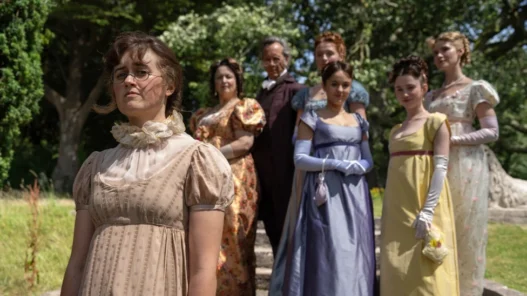
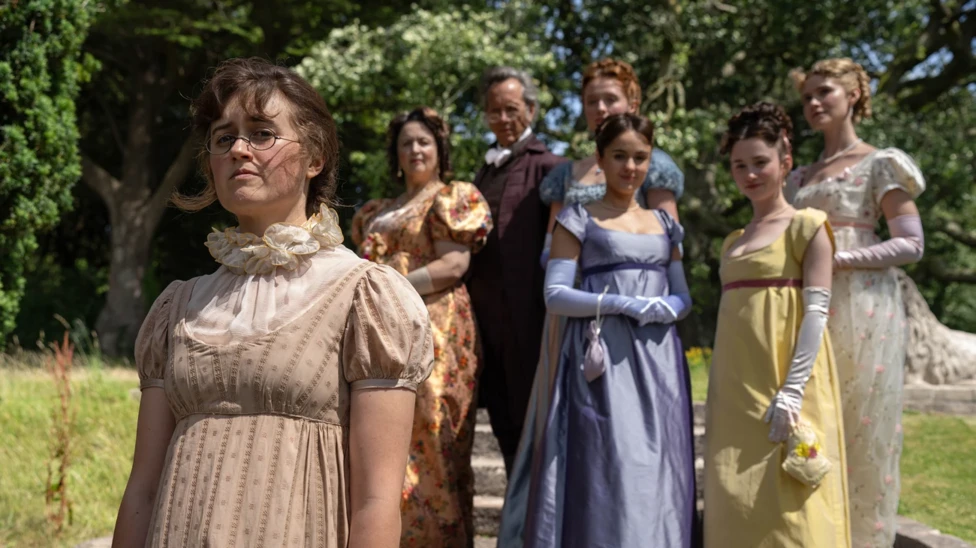
Truth be told, I came to The Other Bennet Sister rather sceptically. The new BBC series, directed by Sarah Quintrell and Maddie Dai based on Janice Hadlow’s 2020 novel, follows the story of Mary Bennet (Ella Bruccoleri), the bookish and awkward middle child of Jane Austen’s Pride and Prejudice – a story, I am now ashamed to say, I did not think required closer inspection.
The current boom in spin-offs, apart from being a lucrative proposition to endlessly expand franchises without exerting one’s imagination and creativity, builds on desires many of us share: we want our favourite stories to never end and we want to keep turning them over, asking the not-so-obvious questions – What if the antagonist is just misunderstood? What if there’s a love story no one knows about? What if an overlooked character holds the key to the plot? And yet, when it came to Mary Bennet, I believed Austen painted a – perhaps unkind but nonetheless precise and entertaining – picture which didn’t need to be overexplained. Mary had all the right to be vain and self-important and judgemental and I had all the right to be more interested in other characters. Besides, if we tried to make a heroine of her, would that mean that we had to look at Mr Collins (Ryan Sampson) as the hero?
My doubts, though somewhat tarnished, persisted through the first two episodes which followed the plot of Pride and Prejudice. While there were references to Austen’s text that I found delightful – the first sentence, written by Hadlow, is a witty paraphrase of Austen’s justly famous opening line: ‘It is a sad fact of life that if a young woman is unlucky enough to come into the world without expectations, she had better do all she can to ensure she is born beautiful’ –, the show seemed unsure about who its protagonist was. These episodes laid the foundation for a new understanding of Mary – mostly by bringing to light the difficulty of growing up ‘plain’ in a household of beauties, under a mother who measures girls’ worth by their looks – and yet, I felt that they struggled to reconcile the events of Austen’s novel with the alternative story they wished to tell.
But as soon as the third episode rolled around and we left the small world of Longbourn, the series simply swept me off my feet. What was up to that point promising but altogether not-quite-there suddenly bloomed into something quite unexpected: sweet, funny, and effortlessly feminist – which, come to think of it, is exactly the sort of transformation Mary goes under.
But what do I mean by the series’ feminism? Growing up, Mary is taught by Mrs. Bennet (Ruth Jones) that to be a woman is to delight, charm, and please – things she finds herself incapable of achieving. To be sure, her sister Elizabeth (Poppy Gilbert) is also admired for her mind, but Lizzy displays her intelligence with confidence and ease which Mary feels she completely lacks. Her sense of failure in the face of expectations placed on women must be familiar to many of us – just like her response is. Concluding that she will never be a ‘proper woman’, Mary decides to swear off everything she considers feminine: nice clothes, thoughts of marriage, and even emotions.
I’m not saying – and neither does the series – that being a woman equates with dressing up and falling in love; but Mary does wish to look nice and find companionship – but decides that she is not worthy of either. As for her resolution to live a rational life, it follows the logic that juxtaposes ration and emotion and attributes the former to men and the latter to women – while in truth, they are both essential and inseparable parts of our ability to make sense of the world.
So, this is where things stand when Mary arrives in London to live with her relatives, the Gardiners. As she begins to settle in her new life – finally able to ‘get out and see the world’ as her family’s housekeeper, Mrs Hill (played by Lucy Briers, the Mary Bennet of the 1995 adaptation) encouraged her to do – her steadfast resolutions begin to be challenged. She meets two men, Mr Hayward (Dónal Finn) and Mr Ryder (Laurie Davidson), who turn out to be passionate readers of poetry. Through their conversations, Mary begins to get in touch with her own feelings, leaving behind the cold rationality she had forced herself into.
Men teaching women to be emotional is already quite something – but The Other Bennet Sister also avoids being a story of male tutelage: Mary returns the favour and challenges the men to read her beloved works of non-fiction, including a multi-volume history book written by Catherine Macauley. Over time, the gradual thawing of her emotions also helps Mary stand up to her own family; her argument with Mrs Bennet is a testament of her courage while the scene in which she confronts Lizzy with the radically different experiences they had growing up is beautifully written and heart-breaking – probably my favourite part in the entire series.
Meanwhile, at the behest of her aunt Mrs Gardiner (Indira Varma), Mary buys two new gowns and – in preparation for a ball – even attempts an onion face mask with her new friend, Ann Baxter (Varada Sethu). While these episodes seemingly follow the well-known script of the makeover – whose success is measured by the newfound ability to appeal to the male gaze –, here we find something else. Mary’s ‘makeover’ is not about unmasking her as an unsung beauty; it is about her starting to feel comfortable after years and years of neglect and abuse.
The face mask does not turn her into a new person; but she makes it with a friend, with a woman who enjoys her company. The clothes she chooses are bright and unusual – Caroline Bingley (Tanya Reynolds), who haunts the series like a brilliant and merciless ghost, makes fun of them –; but they are her choice, and she finds pleasure in them. Thus, when Mary begins to enjoy her life in the city, it is not because she has left her awkward and bookish (and bespectacled!) self behind nor because her beauty makes these traits more appealing; it is because she is slowly letting go of the conviction that she is not worthy of just being herself.
But perhaps most importantly, The Other Bennet Sister gifts us with a feminist icon because Mary Bennet is passionate and ambitious and keeps on failing. From Pride and Prejudice we know her disastrous concert at Mr Bingley’s ball – and the series does not gloss over this but readily admits that she is no great talent. Then, as Mary learns to be kinder to herself, she becomes less bothered by her own shortcomings: when asked, as she’s preparing to climb the mountain Scafell, if she’s ‘skilled at physical pursuits’, her delighted answer is: ‘No! Not in the least, no. But I’m enthusiastic’. Her willingness to admit her limits without being discouraged by them is in part inspired by her friendship with Tom Hayward; in a scene which made me laugh out loud even upon second watching, Mary’s discomfort over her drawing skills disappears as soon as Tom shows her his own – actually terrible – attempts.
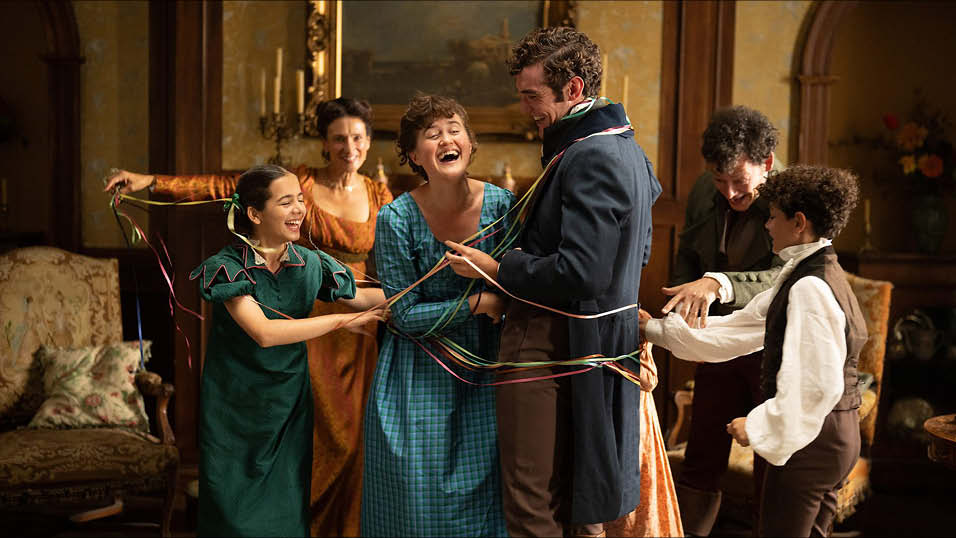
In fact, I’d argue that their fondness for each other and their deep familiarity is rooted in the shared experience of being tryhards: knowing what it feels like to be lacking, to be an outsider (notably, Tom Hayward is played by an Irish actor and although it is never mentioned has an Irish accent) and working tirelessly to improve themselves. This is why it feels so sincere when Tom, upon hearing about Mary’s relationship with her mother, says: ‘I am so sorry that anyone has ever made you feel like a disappointment’, and this is why when he ashamedly admits, ‘I have had to work for everything that I have’, it is the sexiest thing Mary – or we – could imagine.
Mary is our failing hero. Her realisation that enjoyment doesn’t require perfection and that she deserves sunshine just as she is might seem cliched but is nonetheless a lesson we need to be reminded of time and again. Mary goes out into the world being so afraid and ashamed of herself that she uses books – chief amongst them Dr Fordyce’s Sermons to Young Women – to substitute for her own thoughts and emotions. But with time – and with kindness from those around her – she finds the courage to speak and feel for herself.
In the final scene of the season (though not the series as BBC has just announced three additional Christmas episodes!), we see her writing her own book – and while yes, I’ve seen this ending in plenty of other texts, the title of her work, Advice to Young Women, made me feel excited and proud. No longer a hesitant wallflower, Mary has grown up to be a serious, passionate woman who knows that girls do not need sermons – what they do need is to be given advice on how to work and how to fail, preferably by a woman who has had plenty of experience with both.
Written by Hanna Horányi.
Hanna Zelma Horányi is a journalist and writer based in Budapest. She has recently completed her Master’s Degree in Nationalism Studies at Central European University. She is an editorial fellow at HLO – Hungarian Literature Online, an English-language magazine dedicated to Hungarian Literature.
All images used for review only and belong to BBC/Bad Wolf.