







In Bosnia and Herzegovina, peace has officially lasted for three decades. Yet for many people, especially younger generations, the consequences of war are still deeply embedded in everyday life – through political division, inherited trauma, segregated education systems, corruption, and the constant feeling that the country remains trapped between an unresolved past and an uncertain future.
While institutions often speak about reconciliation in abstract political terms, some of the most meaningful work of rebuilding trust and social cohesion has happened far away from government offices and diplomatic conferences. It has happened in classrooms, youth workshops, documentary screenings, local communities, and conversations between young people meeting for the first time across ethnic lines.
At the center of that work stands the Post-Conflict Research Center (PCRC), a Sarajevo-based organization founded by journalist, researcher, and peacebuilding expert Velma Šarić. Through storytelling, investigative research, youth education, art, and citizen journalism, PCRC has spent more than a decade creating alternative spaces for dialogue in a country where political systems continue to reinforce division.
But PCRC is not built around one person alone. The organization is sustained by a network of women who have transformed personal experiences, journalism, education, and activism into practical tools for peacebuilding. Alongside Šarić, women such as Tatjana Milovanović, Erna Mačkić, and Amina Sejfić are helping shape a generation of young people capable of imagining a different Bosnia and Herzegovina.
Their work does not offer simplistic optimism. Instead, it proposes something more sustainable: a long-term, community-based model of healing rooted in storytelling, empathy, youth empowerment, and local participation.
A Different Kind of Peacebuilding
When Šarić founded PCRC, Bosnia’s transitional justice landscape looked very different. Discussions about war crimes and reconciliation largely remained confined to courtrooms, international conferences, and closed workshops attended by small circles of activists and experts.
“I wanted to see how culture and art could become tools that connect people, especially young people,” Šarić explains.
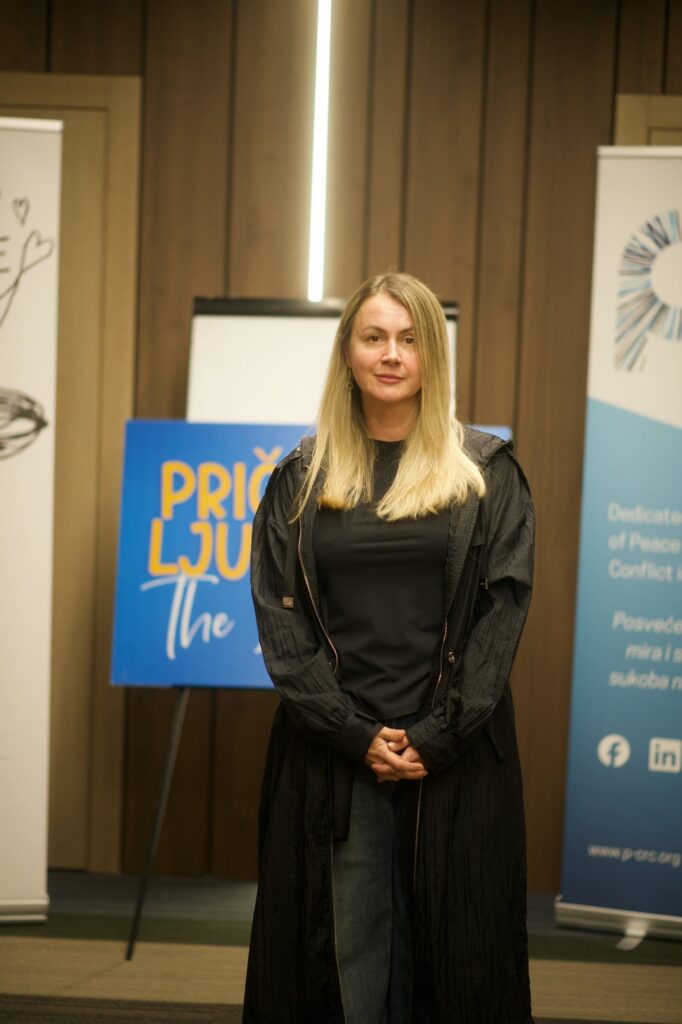
Velma Šarić founded PCRC after years of working as a journalist and researcher documenting war crimes, genocide, and transitional justice across the Balkans, including reporting from the International Criminal Tribunal for the former Yugoslavia in The Hague. Through her experience covering some of the darkest chapters of the Bosnian war, she realized that legal accountability alone was not enough to rebuild divided communities, which led her to create PCRC as a platform that uses storytelling, art, education, and youth engagement to make conversations about peace and reconciliation accessible beyond courtrooms and institutions.
Yet despite years spent documenting violence and legal accountability, Šarić eventually realized that justice alone was not enough to rebuild fractured communities. “The process of dealing with the past was happening behind closed doors,” she says. “I wanted society itself to begin talking about these issues.”
This reflects broader findings in transitional justice scholarship, which argue that formal legal mechanisms are insufficient without participatory and community-based approaches that actively rebuild social trust and enable dialogue at the local level. For example, research on post-war Bosnia and Herzegovina shows that participatory peacebuilding initiatives, such as interethnic dialogue programs and community-driven reconciliation projects, can significantly improve intergroup trust and contribute to more sustainable forms of coexistence beyond institutional justice mechanisms.
That realization became the foundation of PCRC’s approach. Instead of relying exclusively on formal political discourse, the organization began producing documentaries, multimedia exhibitions, storytelling projects, public installations, and youth workshops designed to make conversations about war, memory, and peace accessible to ordinary people.
Their exhibitions appeared in public squares rather than conference halls. Their documentaries reached millions of viewers across the region and internationally. Their workshops brought together young people from communities that rarely interacted.
Over time, PCRC evolved into something broader than a traditional NGO. It became both a peacebuilding platform and an educational ecosystem.
The Generation Born After War
One of PCRC’s central focuses is young people born after the 1992–1995 war, generations that did not experience violence directly but continue to inherit its consequences.
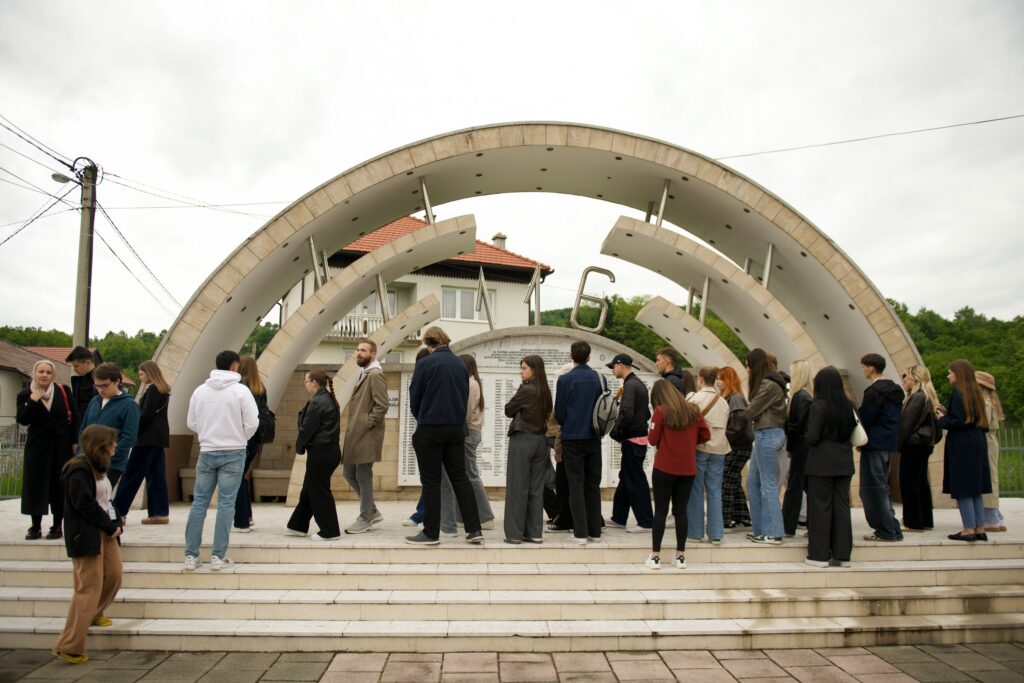
According to Šarić, the most dangerous legacy today is not only ethnic division, but also the normalization of corruption, political manipulation, and hopelessness.
“Young people want to be employed because of their qualifications, not because of political connections,” she says. “But nationalist rhetoric is constantly used to distract people from corruption and systemic problems.”
In many parts of Bosnia and Herzegovina, young people still grow up separated through divided educational systems, conflicting historical narratives, and limited contact with peers from different ethnic backgrounds. The most infamous example remains the “two schools under one roof” system, where students attend the same building while remaining physically and administratively segregated according to ethnicity.
For Milovanović, who has worked with PCRC since its earliest days, these divisions are among the country’s deepest social wounds.
“When I first learned about the ‘two schools under one roof’ system, I couldn’t believe it had become normalized,” she says. “There have been almost no nationally motivated incidents among children in schools for years, yet the segregation remains.”
Milovanović herself came into activism through personal experience. Growing up in Brčko District, she became involved in youth programs focused on addiction prevention after witnessing the devastating effects of post-war trauma and substance abuse within her own family. That early activism eventually led her toward transitional justice and peacebuilding work. Today, as PCRC’s Program Director, she combines legal expertise with extensive experience in youth work and international human rights initiatives.
For her, peacebuilding cannot function through lectures or institutional language alone.
“People connect through stories,” she explains. “Everything else becomes abstract.”
That philosophy shapes many of PCRC’s programs. Rather than presenting reconciliation as a theoretical concept, the organization uses personal narratives, documentary films, photography, and community storytelling to create emotional connections between participants.
A story about a man from Bijeljina rescuing his Bosniak neighbors during the war, Milovanović says, often leaves a stronger impact than statistics or political speeches ever could.
Journalism as a Tool for Healing
A major part of PCRC’s work also operates through Balkan Diskurs, the organization’s youth-oriented multimedia platform founded by Šarić.
Originally created because peacebuilding stories struggled to find space in mainstream media, Balkan Diskurs gradually developed into a platform where young contributors across Bosnia and Herzegovina could publish stories about their own communities.
“We realized that if it was difficult for us to get visibility, how difficult must it be for young people nobody listens to?” Šarić says.

Today, Balkan Diskurs trains young correspondents in journalism, photography, multimedia storytelling, and investigative reporting while mentoring them through the publication process. Many participants receive their first professional opportunities and first paid assignments through the platform.
For editor and researcher Erna Mačkić, this aspect of the work carries enormous social importance. Erna Mačkić, a journalist and editor with years of experience reporting on war crimes trials and judicial institutions in Bosnia and Herzegovina, works through Balkan Diskurs to mentor young contributors from across the country. She sees journalism not only as a tool for documenting the past, but also as a way to empower young people, amplify overlooked local stories, and create networks that bridge ethnic and social divisions.
“Media in Bosnia and Herzegovina still reflect the divisions within society,” she explains. “And as long as the media remains divided, society will remain divided too.”
Through Balkan Diskurs, Mačkić works directly with young contributors from smaller communities often ignored by mainstream media outlets. Many of them are not formally trained journalists. Some study medicine, law, or political science. Others simply want to tell stories from their local environments.
The goal, she says, is not only professional training but also empowerment.
“In smaller communities, young people often have very few opportunities,” she explains. “This gives them a chance to develop themselves, earn their first income, and become active members of society.”
At the same time, the platform creates something Bosnia and Herzegovina often lacks: networks that transcend ethnic and geographic divisions. Young correspondents from different parts of the country collaborate, attend trainings together, and encounter perspectives rarely accessible within their own local environments.
For many participants, it is their first meaningful interaction with peers from other ethnic backgrounds.
Women Carrying the Burden of Peace
Although women were largely excluded from the Dayton Peace Agreement negotiations in 1995, they have become central actors in Bosnia’s post-war recovery process.
That contradiction is something project manager Amina Sejfić reflects on frequently.
“The political system created after Dayton focused on territory and division rather than people,” she says. “But the real work of rebuilding peace moved into the hands of women.”
With academic backgrounds in English literature, security studies, and peace studies, Sejfić represents a younger generation working within transitional justice initiatives while also navigating the frustrations of contemporary Bosnia and Herzegovina.
For her, one of the greatest challenges is combating competing narratives about the past.
“We allowed one historical event to be interpreted in three completely different ways,” she says. “The problem comes when those interpretations contradict judicially established facts.”
Yet despite political stagnation, Sejfić believes younger generations often share far more similarities than differences.
“They listen to the same music, follow the same trends, and face the same existential problems,” she says. “Corruption, poor education systems, lack of opportunities – these are shared realities across Bosnia and Herzegovina.”
This recognition forms a core principle behind PCRC’s work: that sustainable peace cannot emerge solely through institutional reform, but through rebuilding human relationships and creating opportunities for shared experiences.
The Limits of the Solution
PCRC’s model has achieved tangible results. Thousands of young people have participated in workshops, journalism trainings, internships, and peacebuilding programs. Their documentaries and exhibitions have reached audiences far beyond Bosnia and Herzegovina. International organizations have recognized the center’s work through numerous awards, including the Intercultural Innovation Award presented by the United Nations Alliance of Civilizations and the BMW Group.
Still, the organization operates within severe limitations.
Funding for peacebuilding and transitional justice work continues to shrink globally as international attention shifts toward newer conflicts and geopolitical crises. Local civil society organizations increasingly compete with large international NGOs capable of absorbing funding, visibility, and institutional space.
Funding for peacebuilding and transitional justice work continues to shrink globally as international attention shifts toward newer conflicts and geopolitical crises. Local civil society organizations increasingly compete with large international NGOs capable of absorbing funding, visibility, and institutional space. Recent analysis shows that global investment in peace and security is declining despite rising levels of political violence, with preventive funding remaining significantly lower than crisis-response spending—on average, donors allocate several times more resources to managing active conflicts than to preventing them, a pattern often described as the “prevention paradox,” where effective prevention is systematically underfunded because its success is less visible and politically less rewarding than emergency response.
“There is less and less funding for these topics,” Šarić explains. “But the needs are enormous.”
Political pressure also remains constant, especially when dealing with topics such as genocide denial, war crimes, and nationalist narratives. Online harassment and attacks have become routine for activists and journalists working in this field.
At the same time, many local communities across Bosnia and Herzegovina still lack strong civil society infrastructures altogether.
“Peacebuilding became something written in reports and analyses from offices,” Šarić says. “But real work happens on the ground.”
That ground-level work is emotionally exhausting. Listening daily to stories of trauma, violence, and injustice inevitably takes a psychological toll.
“There are moments when it feels like fighting windmills,” Sejfić admits. “But hope comes from small victories – from a young person questioning prejudice for the first time, or communities connecting despite everything.”
A Model Beyond Bosnia
What makes PCRC particularly significant within the broader Eastern European context is its emphasis on scalable, community-based peacebuilding.

Rather than presenting Bosnia solely as a place of unresolved trauma, the organization offers examples of how post-conflict societies can invest in long-term civic resilience through storytelling, youth engagement, and grassroots dialogue.
Their methods – combining art, journalism, education, and local activism – could be adapted far beyond Bosnia and Herzegovina. Countries facing polarization, historical revisionism, social fragmentation, or post-conflict tensions increasingly confront similar challenges throughout Europe and beyond.
Importantly, PCRC’s work also challenges the tendency to reduce post-war societies to victimhood alone.
What emerges instead is a portrait of women building sustainable systems of empathy in environments still shaped by fear and division.
Their work is not dramatic in the way international headlines often prefer. It happens slowly, through mentorships, conversations, films, workshops, and community networks. It rarely produces immediate political victories.
But perhaps that is precisely the point.
In Bosnia and Herzegovina, peace was never something that could simply be signed into existence. For organizations like PCRC, peace remains a continuous process – fragile, unfinished, and deeply human.
And for the women carrying much of that burden, the work continues not because reconciliation is easy, but because abandoning it would mean surrendering the future to the same divisions that once destroyed the country.
Written by Elma Hasanspahić.
Elma Hasanspahić is a communications professional and author from Bosnia and Herzegovina whose work focuses on youth issues, civic engagement, culture, and processes of dealing with the past. Through journalism and storytelling, she explores narratives that open space for dialogue, understanding, and social change, with a particular focus on the experiences of young people in a post-conflict society.