





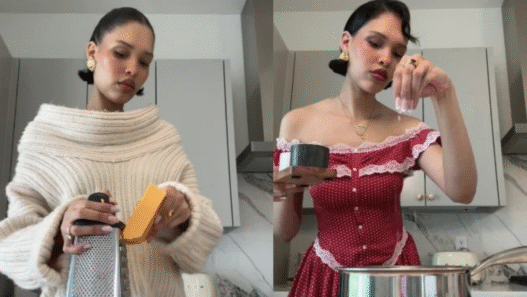



Chanté Joseph’s article “Is Having a Boyfriend Embarrassing Now?” in Vogue truly broke the internet. Why? Because it exposed the contradictions shaping today’s you-go-girl-feminism.
For those who haven’t read it, the piece essentially argues that speaking about our boyfriends – especially online – has become somewhat embarrassing. The moment you do, you risk becoming “boring.” As a result, many women are opting out of posting about their partners altogether, cultivating a mysterious, ambiguous online persona. The internet is divided: on one side, we see a surge of content from it-girls romanticizing singlehood; on the other, a large majority of women still post about their boyfriends in a try-hard attempt to prove that their boyfriend is different, a gem, not trash like the rest.
It’s a great conversation starter, for sure, but I couldn’t help feeling that the article doesn’t explain how we collectively ended up here. So let’s take a step further and ask: what does the “having a boyfriend is embarrassing” phenomenon actually say about us? 
- The increasing disconnect between our online and offline selves
To me, this whole discourse reveals how disconnected our online selves have become from actual reality, where having a partner is not a flex or an accessory, but another human being you build a mutual connection with and share parts of your life with. Yet when I scroll too much, I slip into an alternative reality that’s equal parts conservative (“Whenever I’m traveling with my boyfriend, I can switch off my brain as he takes the lead”) and supposedly empowering (cue sad-girl dinners without protein reframed as “freedom”).
These trends may hold a grain of truth, but the way they dominate my brain – and then affect how I relate to my actual life – is truly frightening. They convince me that having a boyfriend, a normal person with the usual patriarchal leftovers, is something I should hide. It would contradict the one-dimensional image of the powerful, girl-boss woman I’m supposed to be. In this context, it’s not having a boyfriend IRL that feels embarrassing, but showing him off online.
When I was planning this piece, my first point of research was a staple in women’s magazines: our team’s Instagram inspo channel – where the funniest, truest observations tend to occur. Here is where one lazy woman succinctly put it: “Our brains have rotted because of social media and we are all weird as fuck.”
- The overspill effect of the tradwife trend and the rise of conservative rhetoric
“It always felt like a cool-girl move to me not to post the bf (and therefore not conservative).”, said another message in the group, which got me thinking.
Let’s consider this: in a world where old models of heterosexual relationships are resurging, and even dominating global trends, like the tradwife movement, it makes sense that today’s “liberal cool girl” feels that posting or talking about anything that resembles that lifestyle is a no-go. In defining ourselves against the conservative, submissive wifey figure waiting for her husband to come home, we swing to the opposite extreme and feel compelled to uphold an individualistic, independent image, whether or not there’s a hot man knocking on our door in the evening.
In this logic, it’s not just traditional gender norms that get labeled conservative; it’s heterosexual relationships as a whole.
- We are only seen as sexy as long as we’re single
“Having a boyfriend is basically allowing yourself to lose social currency”, reads a new message in the groupchat.
And indeed, following the conservative logic, society makes women feel like their sex appeal evaporates as soon as they are “tied down” or “locked in.” This isn’t at all true for men. If anything, their attractiveness multiplies by being a husband or a “daddy.” For women, as we advance in life, our sexual currency is treated as diminishing: with age, marriage, motherhood, wrinkles, grey hair; one minus point after another.
So in the delicate ages of our late twenties and early thirties, the moment someone announces a marriage proposal, it’s often treated as the tipping point from wild, sexy, and free to middle-class ennui, uninteresting, and, of course, deeply un-sexy.

- Women are craving freedom and not to be defined by their partners
“It’s not in tune at all with what no being partnered up in real life really means for women…it feels more performative”.
Beyond the online-offline dichotomy, there’s also a real-world reason for hiding a boyfriend: the moment you tell friends or family you’ve met someone, every conversation shifts toward them in a way it doesn’t for men. “How is he doing?” becomes the centerpiece of every exchange. You begin to exist as a “we,” and everything you do is measured against how your boyfriend may or may not have reacted. You’re constantly proving he is “the best.”
It’s the opposite of how it is online, yet equally performative. And what a freedom it is to keep a relationship private, to enjoy it while sharing it only with people who truly get it.
I could go on, but one thing still bugs me about the whole discourse: that today’s “slay” feminism defines being feminist against men, but doesn’t go beyond that. Whether you have a boyfriend or not remains the central question of women’s lives. Yes, maybe today not having one can finally be seen as stigma-free (albeit mostly online) instead of sad – but it still narrows our identities down to their relation to the Other.
I can’t help but wonder: instead of taking control and creating dynamics where sexiness isn’t compromised and where we aren’t embarrassed by the complexities of our relationships, isn’t hiding them – or splitting our identities – just an easy fix?
Shouldn’t we cultivate a feminist sense of self that feels cool, individual, and enough on its own, with or without a relationship? And can trends that glorify singlehood really get us there, or are they creating something confusing and disconnected from how we exist in actual society?
You tell me.
Written by Zsofi Borsi.
Zsofi is the editor-in-chief of Lazy Women.